
 Svenska
Cart
Your cart is empty, but doesn't have to be..
Your cart is empty, but doesn't have to be..
Hälla Kafferosteri |15/07, 2026
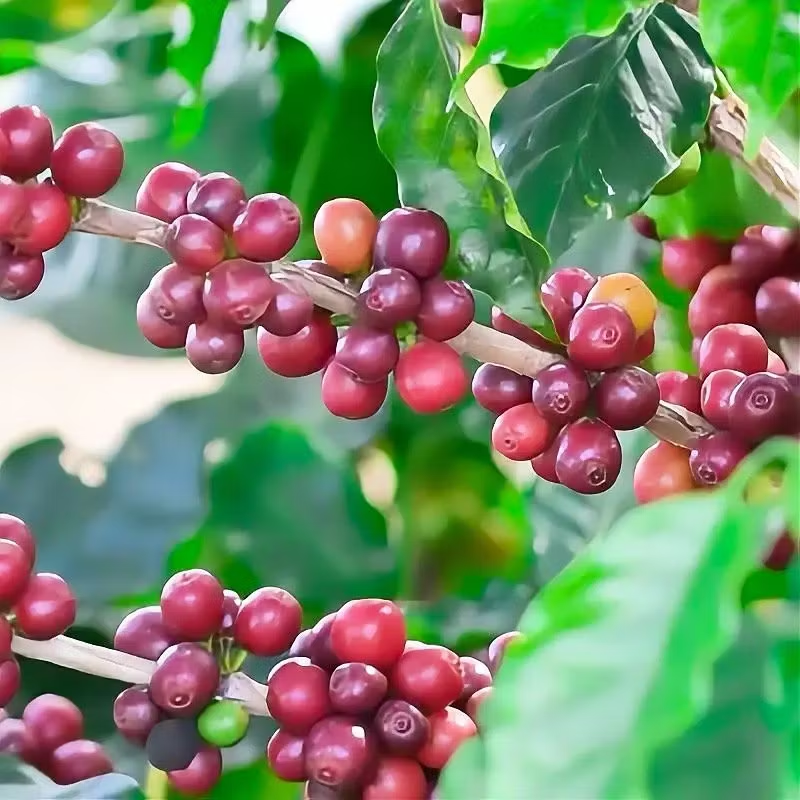
If you've had a coffee from Brazil, Honduras, or Costa Rica recently, there's a very good chance you've had Catuaí in your cup.
The name Catuaí comes from the indigenous South American language Guarani and aptly means "very good" . It is one of Latin America's most important coffee varieties - a reliable workhorse that manages to combine high yield with a fantastic flavour profile.
In this blog post, we take a closer look at the history behind Catuaí, how it is grown, and why it has become a big favorite with both coffee farmers and roasters.
👉 Do you want to learn more about different arbacia varieties?
https://hallakafferosteri.com/blogg/guide
Catuaí is not a natural mutation, but the result of a very successful and careful research effort. The variety was developed in Brazil by the prestigious Instituto Agronômico de Campinas (IAC) .
Back in the 1940s, scientists began experimenting with crossing two of the giants of the coffee world:
Mundo Novo: Known for its enormous growth power and high yields.
Caturra: The compact dwarf mutation of Bourbon known for its low height.
The goal was to create a plant that had the high production of Mundo Novo but the compact, short stature of Caturra. After decades of selection and testing, Catuaí was officially introduced to the Brazilian market in 1972. It was an immediate success and quickly spread to Central America during the 1970s and 80s.
For coffee farmers, Catuaí was a game changer. Because the plants are short and bushy, they can be planted close together, allowing a farmer to produce almost twice as much coffee per hectare compared to older varieties.
Another unique feature highlighted by experts is that the coffee berries are firmly attached to the branches . They do not fall off in the first place, making Catuaí a great choice in regions affected by strong winds or heavy rains at harvest time.
There is a catch, however: Catuaí is a hungry plant. It requires a lot of nutrition, care and fertilization to thrive, and unfortunately it has low resistance to coffee diseases such as coffee rust. But for those farmers who invest time and love in their crops, Catuaí pays for itself many times over in the form of a stable and fine harvest.
As Catuaí ripens, the berries change color, and the variety is mainly divided into two color variants: Red Catuaí and Yellow Catuaí . But do they differ in taste? The answer is yes!
Coffee producers and taste experts (Q-graders) usually describe the differences like this:
Yellow Catuaí: Tends to give a slightly softer and rounder cup with a milder, more subdued fruit acidity. The taste often leans towards the creamy side.
Red Catuaí: Often described as more complex, the red berries generally give a slightly fuller body and a more lively, fruity acidity.
When grown at high altitude and roasted with precision, Catuaí develops a very balanced, clean and incredibly accessible flavour profile. It is the perfect base for those who love a coffee with classic, round flavours.
Typical flavor notes for a well-made Catuaí are:
Sweet milk chocolate and cocoa
Creamy caramel and brown sugar
Nutty undertones, such as almond or hazelnut
Soft hints of honey and subtle spices (e.g. nutmeg)
Here at Hälla Kafferosteri we prefer to give Catuaí a light to medium roast . This allows us to preserve the bean's natural sweetness and subtle acidity, without losing the lovely chocolate and caramel notes. It makes a fantastically delicious brewed coffee, but also works perfectly as a balanced espresso!
Look out for origins like Brazil, Honduras or Guatemala in our webshop – chances are you'll find a fantastic red or yellow Catuaí waiting to brighten your mornings.
👉 Do you want to drink specialty coffee? Then visit our webshop:
Have a nice day!
/ Kaj and Dan, Hälla Coffee Roastery