
 Svenska
Cart
Your cart is empty, but doesn't have to be..
Your cart is empty, but doesn't have to be..
Hälla Kafferosteri |13/07, 2026
Have you ever wondered where the coffee in your cup actually comes from? Not just which country or which farm, but its genetic origins?
If you drink high-quality specialty coffee, chances are you have Typica to thank for the experience. Typica is one of the coffee world’s most important and iconic coffee varieties. It’s not only a fantastic variety in its own right – it’s also the ancestor of a long line of the most beloved coffees we drink today.
In this post, we dive into the history, taste, and challenges behind this legendary coffee plant.
👉 Do you want to learn more about different arbacia varieties?
https://hallakafferosteri.com/blogg/guide
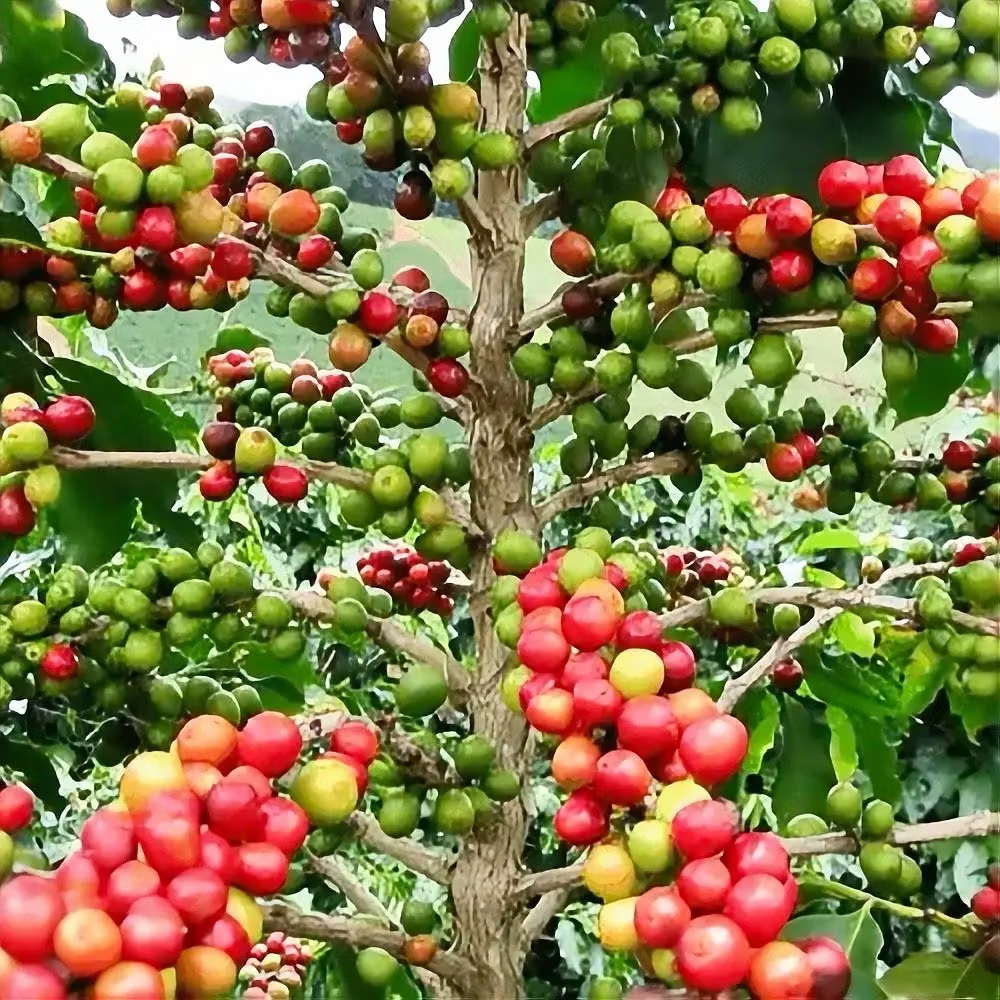
Typica is a specific variety of the species Arabica . Botanically, it is a rather stately tree that can reach up to 5 meters in height. It has a thin trunk and thin branches that are quite far apart. If you look closely at a Typica plant, you will recognize it by its large leaves with characteristic bronze-colored tips, as well as its rather long and narrow coffee berries.
But it is in the cup that Typica truly shines. When the berries are cared for properly, Typica has an outstanding potential for extremely high quality. The flavor profile is often described as:
Elegant and clean
Sweet with a complex acidity
Filled with floral and fruity notes
In short: it's the definition of a truly fine artisan coffee.
The history of Typica is like something out of an adventure book. It all began in the homeland of coffee, the southwestern parts of Ethiopia . From there, coffee made its way to Yemen during the 15th and 16th centuries, and reached India around 1700. The seeds that were then sent to Java in Indonesia are what we now formally call Typica.
During the 18th century, the plant spread at a furious pace across the rest of the world via colonial trade routes:
1706: A single Typica plant is sent from Java to the botanical garden in Amsterdam.
1722: Typica is transported from Europe to South America (Suriname and French Guiana).
1727: The plant reaches northern Brazil and spreads south over the next few decades.
Late 19th century: Typica is grown practically everywhere in Central and South America and in the Caribbean (including Jamaica).
Until the 1940s, Typica was the absolute dominant variety on coffee farms in Central America.
Without Typica, the coffee world would be completely different. Through natural crosses and mutations, Typica has given rise to famous varieties such as Mundo Novo (a natural cross between Typica and Bourbon) and Pacamara (which includes the Maragogipe mutation from Typica).
If Typica is so incredibly delicious, why isn't it the only variety grown? The answer lies in the fact that it is an extremely picky and sensitive plant.
For the coffee farmer, Typica poses a major economic risk. It is highly susceptible to pests and coffee diseases (such as coffee rust). It also produces relatively low yields – Typica produces between 20 and 30% fewer coffee berries than, for example, Bourbon. Because the trees are so large and sparse, they also take up a lot of space on the farm and require more manual labor and maintenance.
Therefore, many producers have replaced their Typica with more modern, more resistant and high-yielding hybrids over the years.
Despite the challenges, Typica has enjoyed a major renaissance in the specialty coffee world. With artisanal roasters and coffee lovers willing to pay more for exceptional quality, it can be very profitable for farmers to continue growing the variety.
One of the most famous examples in the world is Jamaica Blue Mountain . This coffee, which is a pure Typica variety grown at high altitudes, is world-famous for its silky mouthfeel and sweet taste. It is still transported in handmade wooden barrels and sold at exclusive premium prices worldwide. Even in countries like Peru, there is a clear trend today where farmers are consciously returning to Typica in order to offer coffee in the absolute top class.
When you drink a cup of Typica, you drink a piece of living history. It's a reminder of coffee's origins and the craftsmanship that goes into nurturing the delicate plant at high altitude, to the precise roasting in our roastery.
Keep an eye out in our range for coffee varieties that carry Typica genetics – we promise your taste buds will thank you!
👉 Do you want to drink specialty coffee? Then visit our webshop:
Have a nice day!
/ Kaj and Dan, Hälla Coffee Roastery