
 Svenska
Cart
Your cart is empty, but doesn't have to be..
Your cart is empty, but doesn't have to be..
Hälla Kafferosteri |17/07, 2026
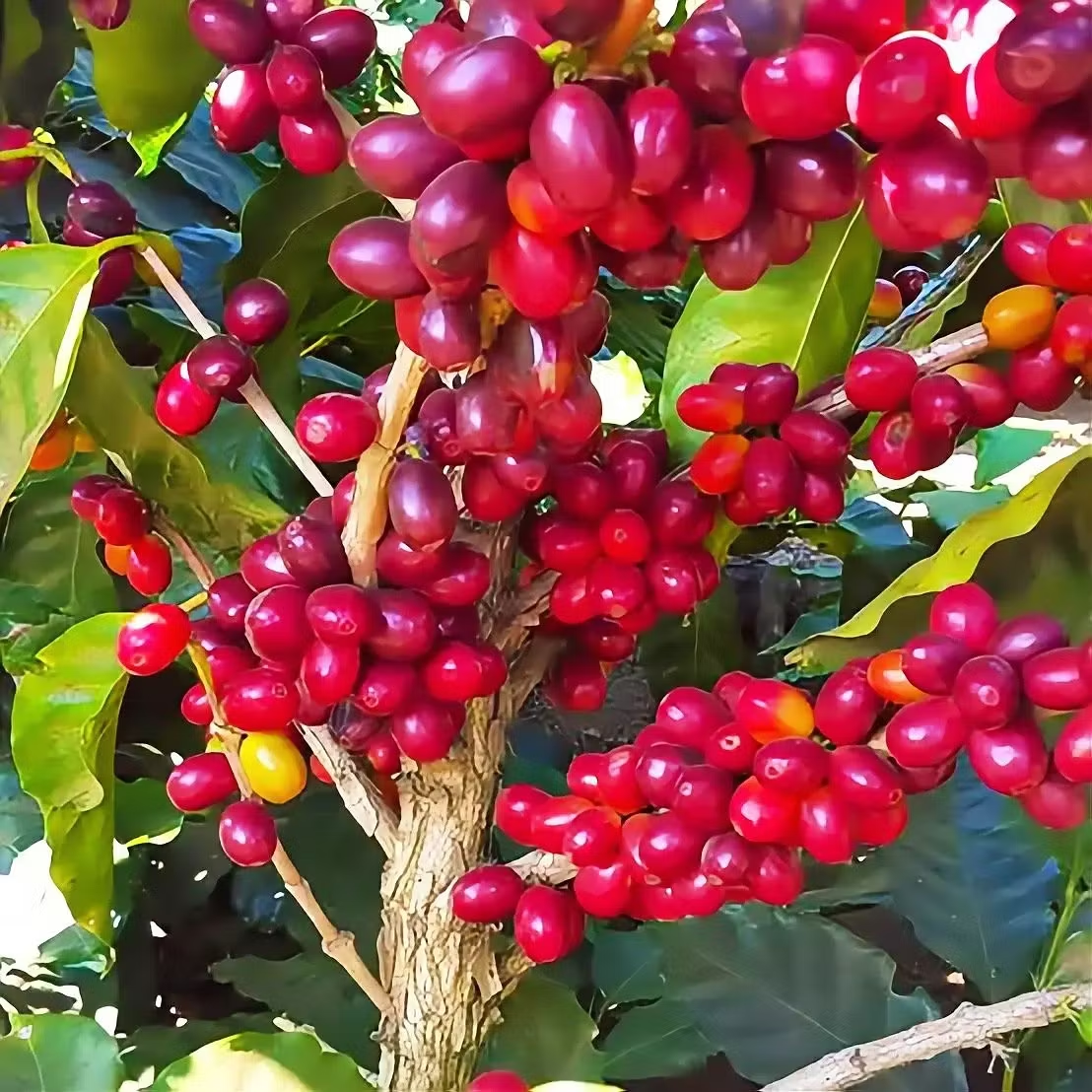
There are coffee beans, and then there are Maragogipe . If you've ever scooped a handful of Maragogipe beans into your hand, you know exactly what we're talking about. They're so huge that they've earned the affectionate nickname "elephant beans."
But Maragogipe is so much more than just a visual spectacle. It is a rare, historic and incredibly elegant coffee variety that offers a taste experience all its own. In this blog post, we explore how this giant bean was born, why it is so rare and what it tastes like in the cup.
👉 Do you want to learn more about different arbacia varieties?
https://hallakafferosteri.com/blogg/guide
Unlike hybrids created in a laboratory, Maragogipe is a completely natural mutation.
The year was 1870 in the small region of Maragogipe, located in the state of Bahia in eastern Brazil . A coffee farmer suddenly discovered that some of his traditional Typica trees were behaving very differently. The trees were growing significantly taller than normal, the leaves were becoming enormous, and – most remarkably of all – the coffee berries and beans inside were becoming gigantic.
It turned out to be a spontaneous gene mutation. The variety was quickly named after the place where it was found, and due to its unique appearance, it soon spread to coffee farms in Guatemala, Mexico, and Nicaragua, among others.
If the beans are twice as big, does that mean the farmer gets twice as much coffee? Unfortunately, it's just the opposite.
Maragogipe is known for having a very low yield . The trees require a lot of space and energy to produce their giant berries, but the number of berries per tree is quite small. In addition, the variety is sensitive to diseases and pests.
Because growing Maragogipe is an economic risk, many farmers have abandoned it in favor of higher-yielding varieties. But in the specialty coffee world, it lives on thanks to passionate producers and roasters who refuse to let this unique flavor disappear. It has also been instrumental in the development of other famous varieties – for example, it is Maragogipe that gave the popular competition bean Pacamara its amazing size and complexity.
Many people mistakenly believe that a giant bean means a super heavy and bitter taste, but the truth is the exact opposite. Maragogipe is known for delivering an incredibly soft, smooth and sophisticated cup.
Characteristics of a well-grown Maragogipe are:
A light to medium body: Silky and pleasant on the palette.
Mild and balanced acidity: Not as crisp or sharp as, for example, a Caturra, but more subdued and round.
Sweet and delicate flavor notes: It is common to find clear hints of light chocolate, roasted nuts, honey and mild floral undertones.
It is a coffee that does not scream for attention, but rather impresses with its harmonious balance and subtle elegance.
Roasting Maragogipe requires extreme sensitivity from our roaster. Because the beans are so large, it takes significantly longer for the heat to travel all the way to the core of the bean.
If you roast too quickly, you risk burning the outside while the inside is still raw. That's why we apply a more gentle roast profile with a gradual heat build-up. We prefer a light to medium-dark artisan roast to really preserve those crunchy, sweet nutty and chocolatey notes that make the coffee so unique.
Drinking Maragogipe is something every coffee enthusiast should try at least once. Keep your eyes peeled for our range – when we get our hands on a batch of this rare giant bean, we roast it with the utmost reverence!
👉 Do you want to drink specialty coffee? Then visit our webshop:
Have a nice day!
/ Kaj and Dan, Hälla Coffee Roastery