
 Svenska
Cart
Your cart is empty, but doesn't have to be..
Your cart is empty, but doesn't have to be..
Hälla Kafferosteri |23/07, 2026
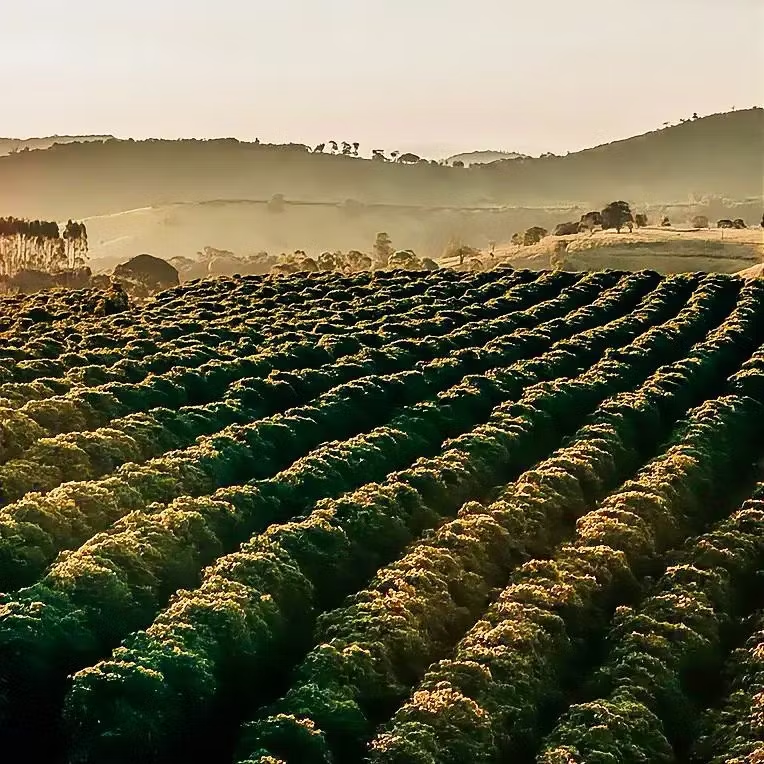
This narrow coastal nation on the Gulf of Guinea has an economy that relies heavily on agriculture. While cotton is the country’s largest export by far, coffee is a mainstay, accounting for around 5% of Togo’s total export earnings. But beneath the surface, a fierce battle for survival is underway, with the goal of restoring the country’s former reputation as a producer of high-quality artisanal coffee.
👉 Do you want to learn more about coffee from different countries?
https://hallakafferosteri.com/blogg/guide
Coffee is not a new fad in Togo. In fact, coffee production has historically been one of the country's most important sources of income and currently employs over 40,000 households.
Throughout the 20th century, Togolese Robusta was renowned and sought after on the world market for its unexpectedly high quality. But around the turn of the millennium, something happened. A combination of drastically reduced investment in the sector and an aging generation of coffee trees caused production to collapse.
The area was halved: Before 2000, coffee was grown on around 40,000 hectares in Togo. Today, that area has been halved to around 20,000 hectares as desperate farmers have been forced to abandon their crops.
The production slump: According to the International Coffee Organization (ICO), Togo produced 6.9 million tons of coffee in 2017. Just three years later, in 2020, that figure had plummeted to 2.4 million tons – a decline of almost 35%.
The pandemic and global logistics crises hit the country's exports hard, as around 98% of all Togolese coffee is sent abroad (mainly to European countries such as France, Belgium, Germany, Italy and Poland).
Despite being a small country, Togo has a fantastic microclimate. All coffee grown here is of the Robusta variety, and it is grown exclusively by small-scale family farms. What is unique is that almost all coffee farmers in Togo co-grow their coffee with cocoa, creating a natural and shady ecosystem for the plants.
Production is concentrated in the southwestern parts of the country, where the terrain rises into lush high plateaus. The most important coffee regions are:
Agou & Kloto (Around the town of Kpalimé)
Danyi
Amou-Okposo
Wawa
It is here, in the Togolese highlands, that local operators like Café Kloto work hard to buy beans directly from farmers and keep local coffee pride alive.
Because Togo focuses entirely on Robusta, the flavor profile is markedly different from East African Arabica bombs. Forget the bright, citrusy acidity of Ethiopia – Togo offers a completely different kind of intensity.
High-quality Togolese Robusta is characterized by a strong, full-bodied body with very low fruit acidity . The flavor notes often draw on dark, bitter chocolate, roasted nuts, earthy undertones and a spicy aftertaste. It is a coffee with enormous character that is excellent for a classic, powerful espresso with a thick crema, or as a stable, full-bodied base in traditional dark roasted coffee blends.
Although the last few decades have been tough, Togo refuses to give up. The country's coffee production is now governed by the CCFCC (Comité de Coordination des Filières Café et Cacao), and they have put their foot down.
The government has rolled out extensive strategies to modernize processing methods, train young farmers, and above all, replace the old, tired coffee trees with new, high-yielding seedlings. The goal is extremely ambitious: to put Togo back on the specialty coffee map and lift the country's production to new heights.
When you drink a cup of coffee with Togolese beans, you not only experience an intense West African flavor profile – you also support thousands of small farmers who are fighting to save their historic coffee heritage.
Want to discover more exciting and unusual coffee origins from all corners of the world? Explore our other origin guides on the blog or stop by our roastery!
👉 Do you want to drink specialty coffee? Then visit our webshop:
Have a nice day!
/ Kaj and Dan, Hälla Coffee Roastery