
 Svenska
Cart
Your cart is empty, but doesn't have to be..
Your cart is empty, but doesn't have to be..
Hälla Kafferosteri |14/08, 2026
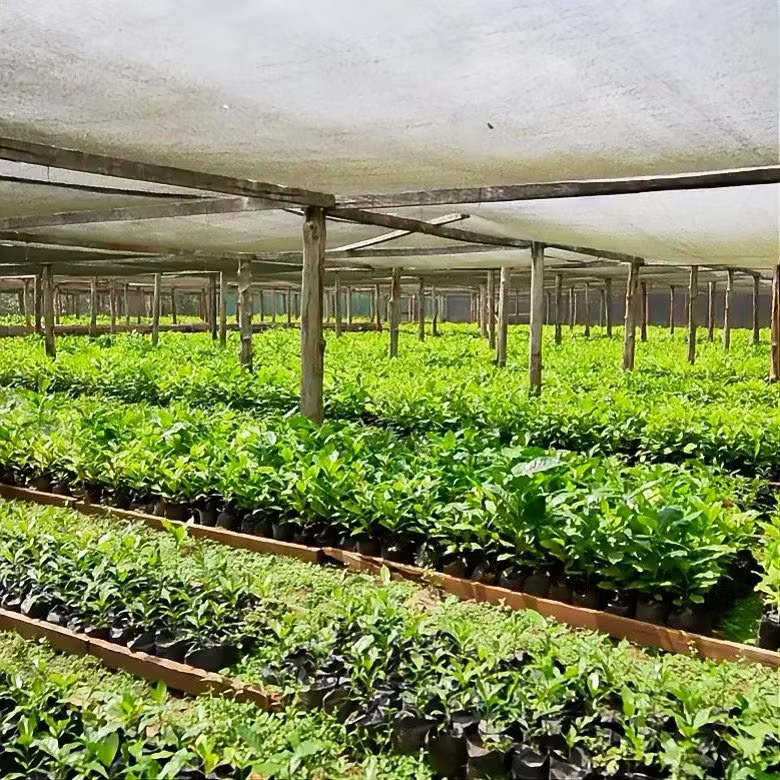
Coffee from South Sudan: History, Genetic Origins & The Rebirth of the Coffee Sector
When we think of the cradle of coffee, our minds almost automatically go to Ethiopia. But new genetic research has shaken up the coffee world: South Sudan is most likely one of the countries of origin of Arabica coffee .
👉 Do you want to learn more about different arbacia varieties?
https://hallakafferosteri.com/blogg/guide
As the world’s youngest nation (independent since 2011), South Sudan has a coffee industry marked by decades of conflict. But behind the challenges lies incredible potential – wild indigenous varieties, unique microclimates and farmers who are slowly rebuilding their coffee production. At Hälla Kafferosteri, we guide you through the history and future of coffee from South Sudan.
Did you know? Although coffee has grown wild in the mountainous regions of South Sudan for thousands of years, the first commercial specialty coffee was exported from the country as recently as 2015 .
Neighboring Ethiopia is often hailed as the sole birthplace of Arabica coffee. However, a scientific study published in Frontiers in Sustainable Food Systems confirmed that South Sudan possesses a unique, indigenous genetic diversity of wild Coffea arabica , particularly around the Boma Plateau and Imatong Mountains .
However, the modern history of coffee in the country has been very dramatic:
Colonial era and early cultivation: During British-Egyptian rule in the 1930s and 40s, the first commercial coffee plantations were established in the Equatoria region.
Civil War and Decay: Decades of civil war in Sudan destroyed the infrastructure. Many coffee farms were abandoned and the coffee bushes were left to grow wild in the jungle.
Post-independence reconstruction (2011): After independence, international initiatives and organizations (including Nespresso and TechnoServe) have worked to revive the sector by helping smallholder farmers form cooperatives and build wet mills.
South Sudan borders three of Africa's largest coffee producers: Ethiopia, Uganda and Kenya. It is mainly in the southern parts of the country that the conditions for quality coffee are perfect:
Central Equatoria State is home to both commercial Robusta and Arabica. The area has rich soil, abundant rainfall and suitable altitude. It is also where most of the new small-scale coffee farmers' cooperatives have been established.
In these inaccessible mountainous areas near the Ethiopian border, unique, indigenous wild Arabica varieties grow at high altitudes. This genetic heritage is of immense value for future coffee research, as these wild varieties often carry natural resistance to drought and plant diseases.
South Sudan still produces very small volumes of coffee and most of it is consumed locally or sold via unofficial border flows to Uganda. The coffee sector faces several challenges:
Infrastructure and logistics: The road network is very undeveloped, making it difficult and costly to transport green coffee beans from the mountain villages to ports for export.
Climate & Security: Recurrent political instability and extreme weather make long-term investments difficult for farmers.
Quality potential: When farmers have access to washing stations and training in drying methods, South Sudanese beans deliver absolutely world-class cup quality.
Because South Sudan has a unique genetic base of Arabica (related to but yet distinct from its neighbors Ethiopia and Kenya), the flavor profile is incredibly exciting.
| Features | Taste description |
|---|---|
| Body | Medium-bodied, balanced and silky |
| Sweetness | Clear hints of honey, cane sugar and dried fruit |
| Fruitiness & Acidity | Fresh and complex with notes of citrus, dark berries and stone fruit |
| Aroma | Floral nuances (jasmine) with a subtle spicy undertone |
Main regions: Central Equatoria (Yei, Lainya) as well as the Imatong Mountains and the Boma Plateau.
Cultivation altitude: 800 – 1,900 meters above sea level.
Main varieties: Native wild Arabica varieties (as well as Robusta in lower terrain).
Harvest period: October to February.
👉 Do you want to drink specialty coffee? Then visit our webshop:
https://hallakafferosteri.com
Have a nice day!
/ Kaj and Dan, Hälla Coffee Roastery