
 Svenska
Cart
Your cart is empty, but doesn't have to be..
Your cart is empty, but doesn't have to be..
Hälla Kafferosteri |30/07, 2026
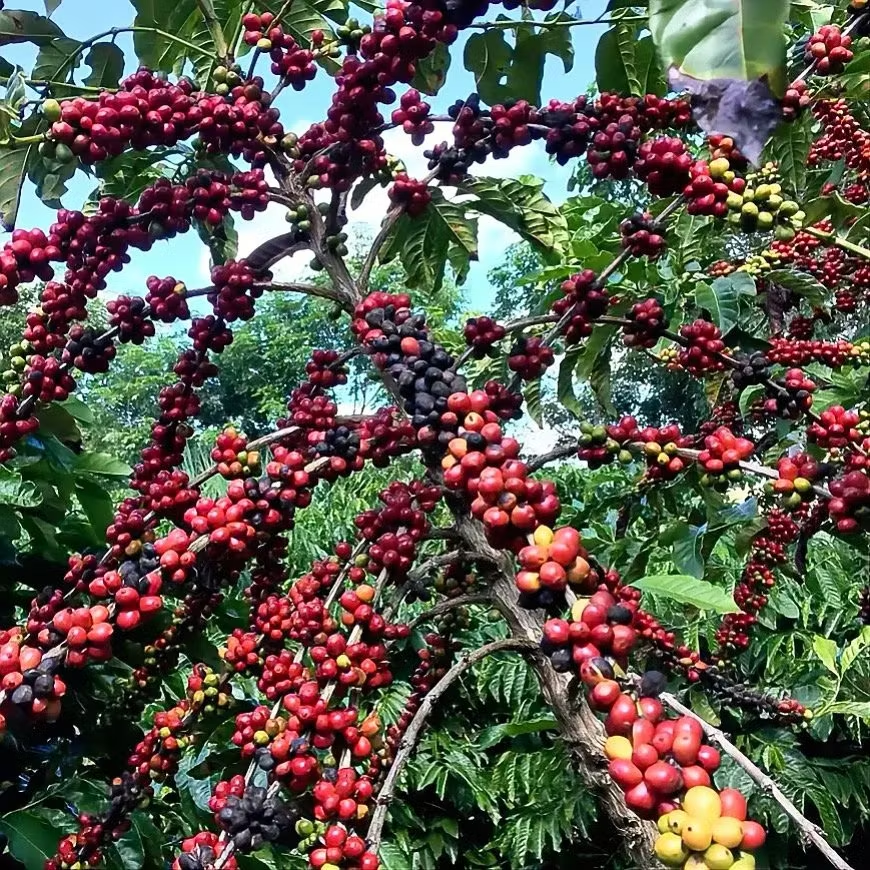
In the shadow of Southeast Asia's more well-known coffee giants, a quiet revolution has taken place in Myanmar (formerly Burma). In just a few years, the country has transformed from an isolated commodity producer to one of the most celebrated upstarts on the global specialty coffee scene.
With exceptional growing conditions in the cool highlands and impressive craftsmanship, Myanmar today delivers microlots that surprise even the most experienced coffee connoisseurs. We at Hälla Kafferosteri guide you through the history, regions and unique flavors behind this fascinating coffee origin.
Did you know? Coffee from Myanmar was officially classified and exported as a highly valued specialty coffee ( Specialty Grade ) for the first time as recently as 2016. In record time, the beans' quality cupping scores have skyrocketed from the 70 mark to over 85–88 points!
👉 Do you want to learn more about coffee from different countries?
https://hallakafferosteri.com/blogg/guide
Coffee was introduced to Myanmar by British colonizers and Catholic missionaries as early as the 1880s, but cultivation remained small-scale and local for more than a century. Decades of political isolation and internal conflict meant that the infrastructure for coffee export was almost non-existent.
The major turning point came during the 1980s and 2000s:
Substitution for opium: The UN and the local government initiated projects to help small farmers in mountain villages replace the illegal cultivation of opium poppies with coffee bushes.
Quality Lift (2014–2015): Through international collaborations with, among others, the Coffee Quality Institute (CQI), local small farmers received training in careful berry harvesting, sorting, and advanced drying methods.
Small-scale empowerment: Today, the coffee sector consists largely of cooperatives and family-owned microfarms where coffee provides a stable, legal and long-term livelihood.
In Myanmar, coffee is grown in a fantastic microclimate that offers hot days, cool nights and rich, reddish-brown soil.
In regions such as Ywangan and Pinlaung in the Shan Mountains, Arabica is grown at altitudes between 1,200 and 1,600 meters above sea level. Small-scale family farms dominate here, often with only a couple of hundred trees in their gardens. The dry, sunny climate during the harvest season makes the area perfect for sun-dried coffee ( Natural process ).
In the highlands around Pyin Oo Lwin you will find slightly larger farms and a processing center. Here, mainly tight and clean washed coffee of very high quality is produced.
The specialty coffee movement in Myanmar is characterized by extreme meticulousness and a willingness to experiment:
Precision harvesting: The berries are hand-picked with surgical precision – only perfectly deep red berries are used.
Raised drying beds ( African beds ): The berries are dried under close supervision on airy beds in the sun to avoid over-fermentation and ensure a clean flavor profile.
Variety diversity: Here you will find classic, aromatic Arabica varieties such as Costa Rica , S795 , Catuai , Bourbon and SL34 .
Arabica from Myanmar stands out for its exceptional purity, natural sweetness and vibrant fruit tones.
| Process method | Typical taste description |
| Natural (Sun-dried) | Complex and juicy with sweet notes of blueberries, strawberries, dried fruit, dark chocolate and floral notes |
| Washed | Clean, elegant and balanced with notes of citrus, green apples, brown sugar and a silky body |
Main regions: Shan State (Ywangan, Pinlaung) and Mandalay (Pyin Oo Lwin).
Cultivation altitude: 1,100 – 1,600 meters above sea level.
Main varieties: SL34, S795, Catuai, Caturra, Catimor, Bourbon and Typica.
Harvest period: December to March/April.
Processing methods: Natural (sun-dried on raised beds) and Washed.
👉 Do you want to drink specialty coffee? Then visit our webshop:
Have a nice day!
/ Kaj and Dan, Hälla Coffee Roastery