
 Svenska
Cart
Your cart is empty, but doesn't have to be..
Your cart is empty, but doesn't have to be..
Hälla Kafferosteri |24/07, 2026
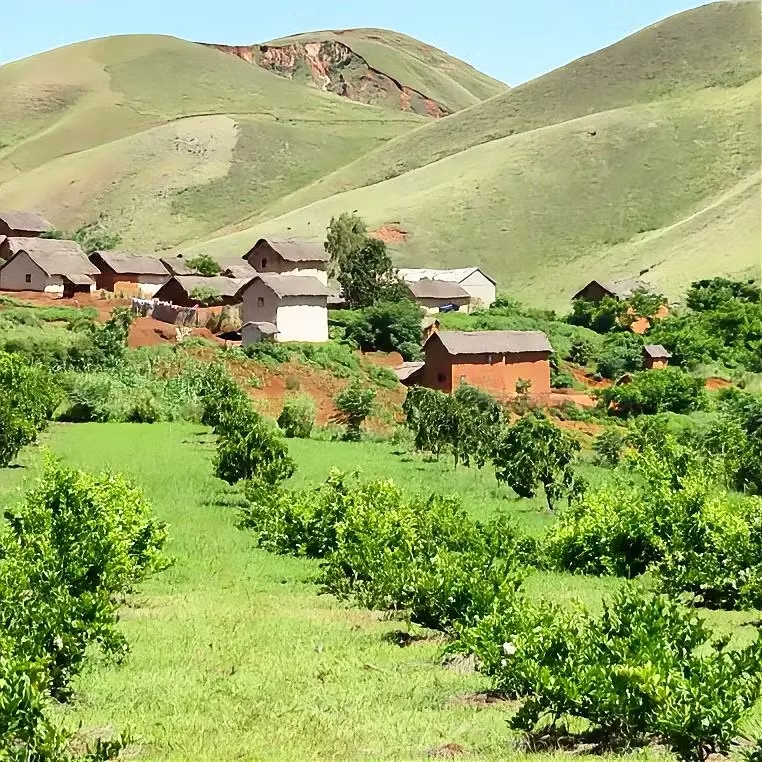
When most people think of Madagascar, they immediately think of unique lemurs, majestic baobab trees and fragrant vanilla plantations. But this huge island in the Indian Ocean also hides one of the coffee world's most fascinating and least explored treasures.
Madagascar is a country with a unique biodiversity – in fact, over 70% of the island’s species are endemic (meaning they are found nowhere else on earth). This also applies to coffee. The island is home to a whopping 65 unique, wild coffee species! Despite its rich history, Madagascar has long been a hidden gem on the international specialty coffee scene. But now an exciting movement is underway with the goal of putting the island’s artisanal coffee on the world map.
👉 Do you want to learn more about coffee from different countries?
https://hallakafferosteri.com/blogg/guide
Coffee was introduced to Madagascar in the mid-to-late 19th century by French colonists. They quickly realized that the island's diverse microclimate and volcanic soils were perfect for coffee cultivation. Coffee soon became one of the country's most important exports, and the high-quality Bourbon Arabica that was grown quickly became very popular in Europe.
But coffee in Madagascar is not just about export – it is a deep-rooted national obsession. All around the island's streets you will find a bustling network of coffee vendors, often women, who run small improvised coffee stands.
This is where locals buy their morning coffee, traditionally roasted on site in a simple pan over an open fire, ground with a mortar and pestle, and brewed strong. The coffee is drunk piping hot and almost always enjoyed with mokary (sweet, fried rice cakes) or mofo baillon (fried dough balls) – a breakfast that provides energy and community in Malagasy everyday life.
Coffee production in Madagascar is divided into two distinct worlds, governed by the island's dramatic geography. Most of all coffee is grown organically on smallholder farms , but often not entirely out of free will, but rather because the farmers lack access to commercial fertilizers.
Production is divided into the following regions:
The tropical east coast (Robusta): Around 90% of the country's coffee is produced here. Robusta grows at low altitudes (100–300 meters above sea level) in warm, humid regions such as Vatovavy, Fitovinany, Antalaha and Tamatave. It is harvested from June and July.
Central Highlands & Sambirano Valley (Arabica): Here, at higher altitudes and in cooler microclimates, the remaining 10 percent Arabica is grown. This is where the island's specialty coffees come from, with varieties such as classic Bourbon and Typica . Harvest takes place between April and July.
Depending on whether you drink the widespread Robusta or the rare Arabica, Madagascar offers two completely different taste experiences:
Malagasy Arabica (Specialty) When grown and processed with care, Malagasy Arabica is of extremely high quality. In recent cuppings, the beans have been scored around 83-84 points by professional Q-graders. The taste is clean and full-bodied, with balanced acidity and complex notes of citrus, spice, floral notes and a subtle aftertaste of tropical fruit.
Traditional Robusta The island's Robusta has a very strong, heavy body with low acidity. When dark roasted in the traditional Malagasy way, it takes on an intense character with deep undertones of dark chocolate, toasted wood and earthiness - perfect for those who want to experience coffee exactly as the locals drink it.
Madagascar has had huge success in recent years exporting other luxury commodities, most notably its world-famous bourbon vanilla and cloves. Now the coffee industry hopes to apply the same recipe for success to coffee.
By investing in better processing stations, training farmers in modern quality control, and building bridges to international specialty coffee roasters, the goal is to transform Madagascar’s coffee production from anonymous bulk coffee to traceable specialty coffee. In addition, new projects focus on agroforestry – growing coffee in the shade of natural forests to protect the country’s threatened and unique biodiversity.
Drinking a cup of carefully selected coffee from Madagascar is more than just a unique taste experience. It's a journey to one of the most unique places on earth, and a direct support for the small-scale farmers who are fighting to lift their heritage out of the shadows.
Want to travel further into the fantastic world of coffee? Explore our other origin guides on the blog or take a look at our roastery to discover new exciting beans!
👉 Do you want to drink specialty coffee? Then visit our webshop:
Have a nice day!
/ Kaj and Dan, Hälla Coffee Roastery