
 Svenska
Cart
Your cart is empty, but doesn't have to be..
Your cart is empty, but doesn't have to be..
Hälla Kafferosteri |29/07, 2026
Coffee from Laos: History, the Bolaven Plateau & The Hidden Coffee Revolution
When coffee lovers look to Southeast Asia, the spotlight often falls on giants Vietnam and Indonesia. But hidden in the shadows of its neighbors lies Laos – one of the region’s most exciting and untouched coffee countries.
With a combination of mineral-rich volcanic soil, cool highland climate and a strong emerging specialty coffee culture, Laotian coffee is making a quiet but powerful entrance onto the global coffee scene. At Hälla Kafferosteri, we guide you through the history and flavors behind this fascinating origin.
Did you know? Around 95% of all coffee in Laos is grown in one place – the mighty Bolaven Plateau in the south of the country. Its unique volcanic soil and cool microclimate make it one of Asia’s best coffee growing areas.
👉 Do you want to learn more about coffee from different countries?
https://hallakafferosteri.com/blogg/guide
The history of coffee in Laos began in the early 1900s when French colonizers planted the first coffee bushes on the Bolaven Plateau. The French quickly realized that the rich volcanic soil and high altitude were ideal for quality coffee.
However, during the mid-20th century, the coffee industry suffered severe setbacks:
Diseases and frost: Outbreaks of coffee frost (a fungal disease) and unexpected frosty nights wiped out large parts of the sensitive Arabica plantations.
The scars of war: During the Indochina War, the eastern and northern border areas of Laos were heavily bombed. Even today, unexploded ordnance ( UXO ) clearance limits the amount of new farmland that can be safely cultivated.
To survive, most farmers switched to more hardy Robusta and the crossbreed Catimor in the 1950s and 60s. But in recent decades, a new wave has swept the country: the government and international initiatives are now helping small-scale farmers return to high-quality Arabica varieties to meet the global demand for specialty coffee.
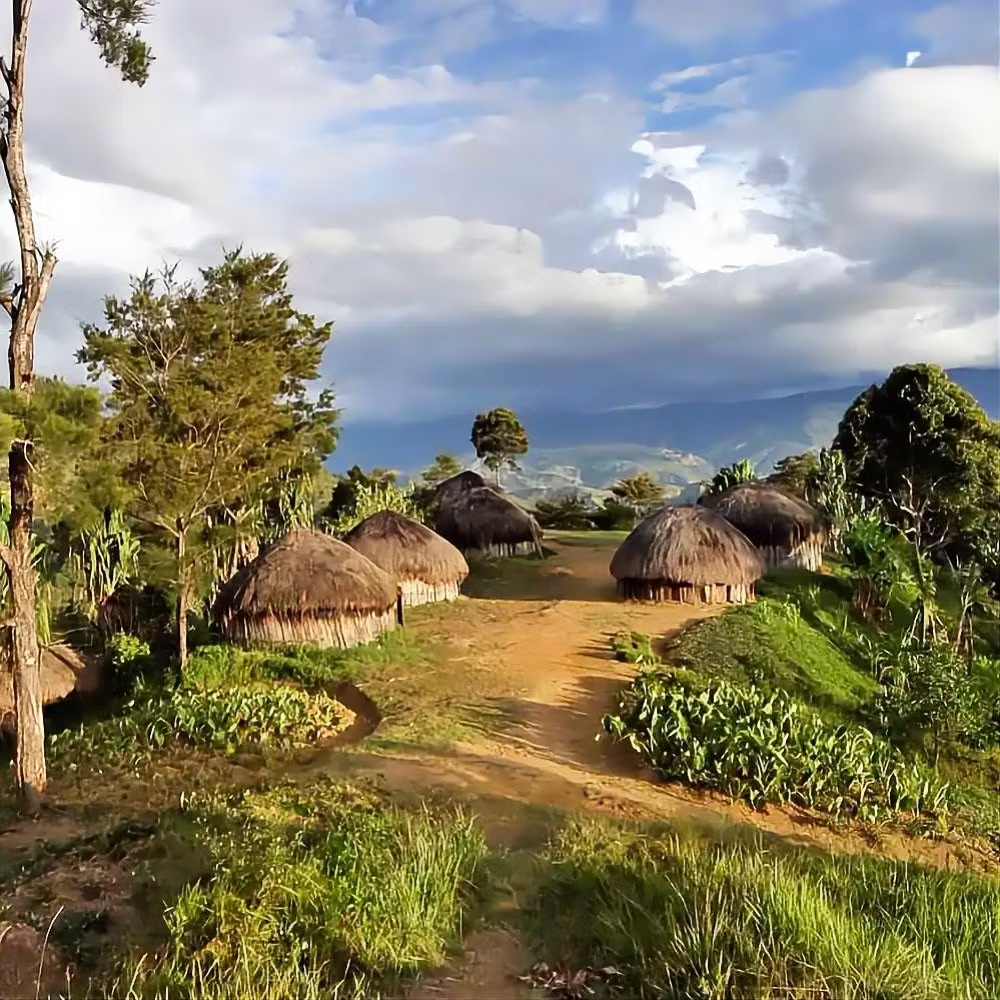
Southern Laos is dominated by the Bolaven Plateau (which ranges in elevation from 1,000 to 1,350 meters above sea level). The plateau offers a cool climate, abundant rainfall, and nutrient-rich soil from extinct volcanoes. This allows the coffee berries to ripen slowly, building up a high concentration of natural sugars and complex aromas.
Meanwhile, coffee cultivation has spread northwards in recent years to mountainous regions such as Houaphanh and Luang Prabang . Here, local hill people grow Arabica under shady tree frogs ( shade-grown ), which gives it a completely unique character while protecting local biodiversity.
Traditionally, Lao coffee has been exported in bulk as a commercial commodity (mainly Robusta to countries such as Germany and the USA). But domestically, a strong transformation is underway:
From quantity to quality: Farmers receive training in careful hand-picking (only deep red, fully ripe berries) as well as controlled washing and drying processes.
Local micro-roasting boom: In the capital Vientiane and the tourist haven of Luang Prabang, a vibrant coffee culture has emerged. Local roasters buy their beans directly from the villages ( Direct Trade ), ensuring that farmers are paid significantly more than the market price.
Economic empowerment: For tens of thousands of families in Laos' mountain villages, switching to specialty coffee has become a way out of poverty, with the income going directly to healthcare, schooling, and better living conditions.
Coffee from Laos often surprises with its smoothness, balanced body and rich depth of flavor.
| Features | Taste description |
| Body | Full-bodied, silky and syrupy mouthfeel |
| Sweetness | Clear notes of milk chocolate, crackers, brown sugar and roasted nuts |
| Fruitiness & Acidity | Mild and pleasant citrus, red berries, stone fruit and subtle floral nuances |
| Aftertaste | Long, clean and smooth with a warm spiciness |
Main regions: Bolaven Plateau (Champasak, Salavan, Sekong) as well as Houaphanh and Luang Prabang in the north.
Cultivation altitude: 800 – 1,350 meters above sea level.
Main varieties: Robusta (accounts for the majority), Catimor, Typica, Bourbon and Caturra (Arabica).
Harvest period: November to March.
Processing methods: Washed dominates for Arabica, but Honey and Natural are becoming increasingly common for microlots.
👉 Do you want to drink specialty coffee? Then visit our webshop:
Have a nice day!
/ Kaj and Dan, Hälla Coffee Roastery