
 Svenska
Cart
Your cart is empty, but doesn't have to be..
Your cart is empty, but doesn't have to be..
Hälla Kafferosteri |14/03, 2023
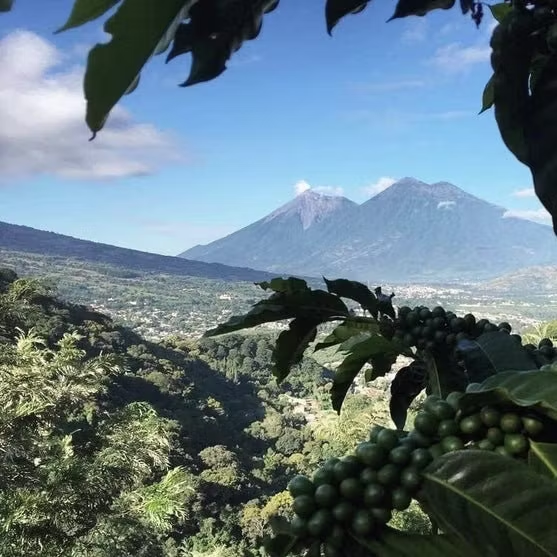
Guatemala, located in Central America between the Pacific and Caribbean Seas, is one of the world's most respected origins of specialty coffee . The country is known for its dramatic volcanic landscapes, rich cultural heritage – and above all, its high-quality coffee.
But what really makes Guatemalan coffee so unique? The answer lies in the combination of history, high-altitude cultivation, volcanic soil and a varied microclimate.
Coffee cultivation in Guatemala dates back to the 18th century, but it was during the 19th century that production really took off. During the latter part of the 19th century, coffee became one of the country's most important exports and a crucial part of Guatemala's economy.
International investment poured in, and the coffee industry quickly developed into one of the country's most important sectors. Today, Guatemala is one of the world's leading producers of high-quality Arabica coffee , especially in the specialty coffee segment.
Guatemala's unique geographical location creates optimal conditions for coffee cultivation.
The country's many volcanoes provide nutritious, mineral-rich soil that contributes to the coffee's complex flavor profile.
The coffee is grown at altitudes between 1,400 and 3,000 meters above sea level. The high altitude means that the coffee berries ripen more slowly, which develops more sweetness and clearer flavor nuances.
Mountain ranges and proximity to two oceans create varying microclimates. Differences in rainfall, temperature and soil mean that each region produces coffee with its own character.
The soil – with its minerals, organic matter and pH value – directly affects the development of coffee beans and thus the taste, acidity and body.
Although coffee is grown in large parts of the country, there are three regions that particularly stand out:
Antigua is one of Guatemala's most historic coffee regions and is surrounded by three volcanoes. Coffee is produced here with:
Full body
Clear chocolate tones
Mild, elegant acidity
It is a classic and well-balanced coffee that is suitable for both brewed and espresso.
Cobán is characterized by high humidity and frequent rain, which prolongs the flowering and ripening process of the coffee.
It requires more work when sorting the coffee berries, but the result is often:
Deep sweetness
Spicy notes
Soft and round acidity
Huehuetenango is one of the highest coffee regions in Guatemala. The extreme altitudes combined with dry winds create ideal conditions.
Coffee from here is often:
Complex
Fruity
Elegant with lively acidity
This is also where many of Guatemala's most award-winning specialty coffees come from.
Guatemalan coffee is known for its:
Plump body
Clear notes of chocolate, nuts and caramel
Lively but balanced acidity
Long, sweet aftertaste
In some regions, you can also find hints of red berries and citrus, which gives the coffee a fresh and nuanced character.
This complexity is a direct result of the country's varied geography, elevation differences, and volcanic soils.
Coffee is not just an export product – it is the lifeblood of the country's economy and culture.
Over 125,000 families in Guatemala depend on coffee farming for their livelihood. Many are small-scale producers who grow coffee using traditional methods that have been passed down for generations.
When you choose coffee from Guatemala, you are therefore supporting both the craft and the families who keep the tradition alive.
The same coffee can taste completely different depending on the roasting and brewing method.
A medium-roasted single origin from Guatemala highlights:
Round chocolate tones
Soft sweetness
Finishes with red berries and citrus
Perfect for pour over, brewer or press jug.
A slightly darker roast gives:
Powerful body
Spicy notes
Extra intensity
Perfect as a double espresso or in cappuccino where the sweetness of the milk balances the acidity.
The fascinating thing about coffee from Guatemala is how diverse it is. The same origin can express itself completely differently depending on:
Roasting degree
Brewing method
Grinding degree
Extraction time
Experimenting is part of the experience.
Want to discover the difference for yourself? Try Guatemala in different roasts and brewing methods – and find your personal favorite.
Hope your day is filled with lots of really good cups ☕
/Roaster Dan