
 Svenska
Cart
Your cart is empty, but doesn't have to be..
Your cart is empty, but doesn't have to be..
Hälla Kafferosteri |31/08, 2023
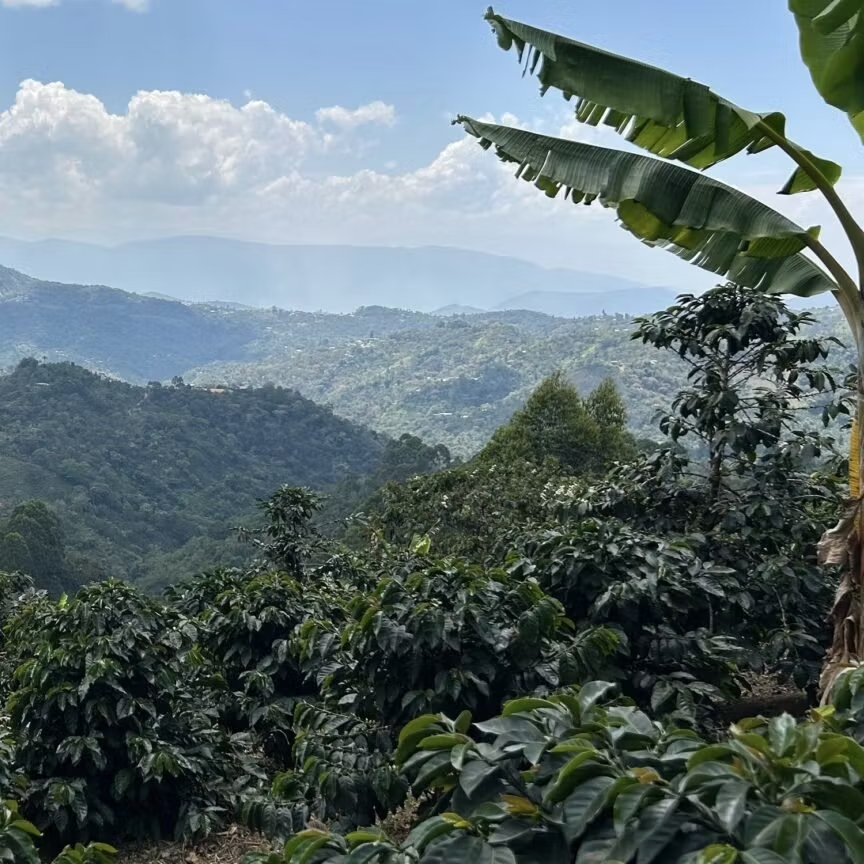
There is a persistent myth in the coffee world: that Peru “learned” coffee production from Colombia. This is simply not true.
In fact, coffee was grown in Peru as early as the 18th century, while Colombia's commercial coffee production did not take off until the early 19th century.
The difference instead lay in strategy:
Peru cultivated mainly for domestic consumption
Colombia invested early in exports
This meant that Colombia quickly established itself globally, while Peru remained more locally rooted – despite a long and solid coffee tradition.
When the coffee disease Coffee Rust began to hit plantations in Java and Sri Lanka hard, the playing field changed.
European operators began to seek new areas for coffee production, and Peru proved to be an ideal candidate:
Fertile soils
High altitudes
Stable climate
The English invested heavily in Peruvian coffee plantations, which led to a rapid increase in production.
After the two world wars, England withdrew from Peru, and the local farmers were suddenly responsible for producing and exporting coffee themselves.
The best farms were often family-owned, and although the quality remained high:
Reduced production volume
Exports became more limited
Competition from Colombia increased
Colombia continued to expand and strengthened its position globally, while Peru lost momentum.
Peru has recently faced several major challenges:
Guerrilla conflicts that have affected the countryside
Lack of infrastructure
Limited export opportunities
At the same time, the country was hit by the same problem that once fueled its rise – Coffee Rust.
Coffee Rust is a fungal disease that attacks coffee bushes and greatly reduces yields.
In Peru, the Arabica variety Typica was mainly grown, which proved to be particularly sensitive to the disease.
To save production, many growers began to switch to:
Catimor – a more resistant variant
This meant:
More stable harvests
Recovery in production
A path back to the export market
Today, Peru is one of the world's ten largest coffee producing countries – even though its coffee is still relatively underrated.
Peruvian coffee is known for its accessible yet complex profile.
Typical tasting notes:
Candy
Honey
Chocolate
Mild fruitiness
Cupping is often:
Soft
Balanced
Clean in the aftertaste
This makes Peru a perfect origin for both beginners and experienced coffee enthusiasts.
Want to discover Peru in a cup? Here are two current examples:
A farm named after the hummingbird, located in the Amazon region.
Powered by Ylder Herrera
Family with a long coffee tradition
Lightly roasted profile
Taste:
Full body
Candy
Sweet honey
A regional coffee from Cajamarca, produced through a cooperative that empowers women in the coffee industry.
Café Femenino works actively to:
Give women control over income
Securing land ownership
Recognizing their work
Profile:
Middle grate
Balanced
Soft and easy to drink
A coffee that not only tastes good – but also makes a difference.
Peru is one of the world's most underrated coffee producers.
It offers:
A long and rich coffee history
High-quality specialty coffee
Sustainable and small-scale production
Social impact through cooperatives
Despite challenges, Peru has risen and reclaimed its place on the global coffee scene.
For those who want to discover something genuine, balanced and often overlooked – Peru is an obvious choice.
Are you ready to give Peru the attention it deserves?
Explore our range of Peruvian coffee – carefully selected for quality, origin and taste.