
 Svenska
Cart
Your cart is empty, but doesn't have to be..
Your cart is empty, but doesn't have to be..
Hälla Kafferosteri |12/06, 2026
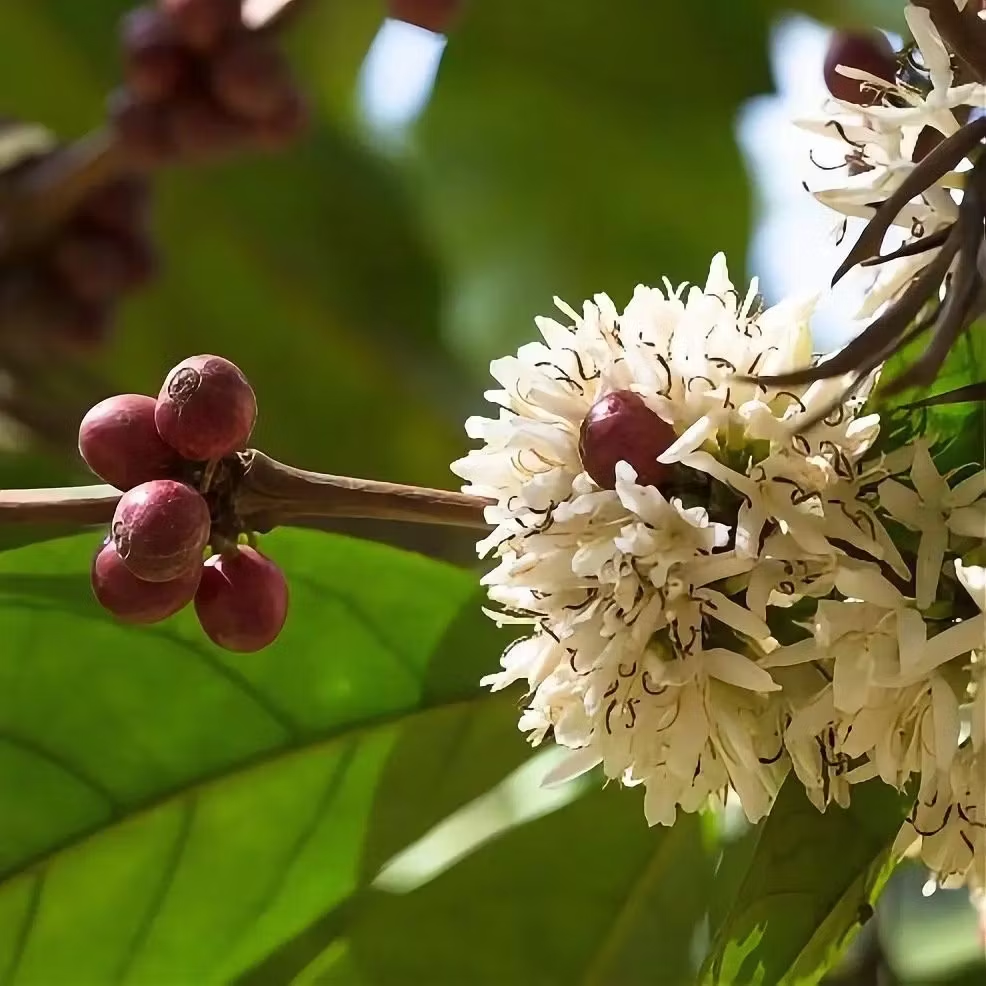
When we talk about coffee, the discussion is almost exclusively about two giants: Coffea arabica and Coffea canephora (better known as robusta). Together they account for around 99% of the global coffee market. But hidden in the shadow of these two is a third, almost forgotten species that is currently making a sensational comeback in the specialty coffee world.
Welcome to the definitive guide on Coffea liberica – the species with the giant beans, the wild history, and a flavor profile unlike anything else you've tasted.
👉 Want to learn more about the difference between Arabica and Robusta? Read more here:
Coffea liberica is a completely different type of coffee, originally native to the tropical lowland areas of West and Central Africa (especially in countries such as Liberia, Ivory Coast and Angola).
While the arabica bush is relatively small and delicate, liberica is a robust, stately tree. In the wild in the African forests, a liberica tree can reach a height of 15 to 20 meters .
The leaves: The leaves are enormous, leathery and significantly larger than those of arabica and robusta.
The Berries and Beans: Liberica coffee berries are the largest in the coffee family. The beans themselves have a characteristic, asymmetrical shape with a curved "s-line" in the middle and a pointed end - they almost resemble small boats.
Pulp-to-bean ratio: The berries have a very thick and sugary pulp (pulp). This protects the bean but also makes it more challenging to process and dry.
If you're expecting the tart, berry flavor of an Ethiopian Arabica, Liberica will come as a shock. Liberica coffee is known for having an extremely distinct, heavy, and complex flavor profile. It's often described as "polarizing" - you either love it or it takes some getting used to.
Typical flavor notes for high-quality liberica include:
Sweetness and fruitiness: Ripe jackfruit, banana, mango and sometimes a hint of fermented citrus.
Body and smokiness: A very full, almost creamy body ("heavy mouthfeel") with hints of dark chocolate, spices, tobacco and sometimes a subtle smokiness.
Woody and floral undertones: Anise, licorice and sometimes a floral aroma reminiscent of jasmine.
Thanks to its thick, sugary pulp, liberica often has a naturally low acidity but an extremely long, sweet aftertaste.
During the late 19th century, Liberica was close to becoming the world's dominant coffee variety.
In 1890, the world's coffee plantations – especially in Southeast Asia (Indonesia, the Philippines, Sri Lanka) – were hit by the devastating fungal disease Coffee leaf rust ( Hemileia vastatrix ). The disease wiped out almost 90% of all Arabica coffee in the region and threatened to disrupt the global coffee supply.
Because liberica proved to be much more resistant to leaf rust than arabica, millions of plants were shipped from West Africa to Asia to save the industry. For a few decades, liberica was the absolute largest coffee in countries like the Philippines and Malaysia.
As the market stabilized and robusta coffee was introduced (which was even easier to grow, gave higher yields and had smaller berries to suit industrial machines), liberica was gradually phased out. In addition, the enormously tall trees made harvesting dangerous and time-consuming, as pickers had to climb high ladders in the jungle.
Today, Liberica makes up less than 1% of the world's commercial coffee production. If you want to drink real Liberica, these are the main regions to turn to:
Philippines: Here the coffee is locally called Barako (meaning "wild boar" or "macho" in Tagalog, a nod to the coffee's strong and robust flavor.) It is deeply rooted in Filipino culture.
Malaysia & Indonesia: In Malaysia, liberica accounts for a significant portion of local coffee consumption, where it is often roasted with sugar or butter (so-called Copy ).
In countries like Liberia and Sierra Leone The trees still grow wild in the forests. There are currently several international and local projects underway to help farmers rebuild the infrastructure so they can begin exporting the species as an exclusive specialty coffee.
+------------------------+--------------------------+--------------------------+ | Egenskap | Coffea Arabica | Coffea Liberica | +------------------------+--------------------------+--------------------------+ | Optimal odlingshöjd | Hög (600 - 2000+ m) | Låg (0 - 500 m) | | Trädstorlek | Liten buske (2-5 m) | Stort träd (15-20 m) | | Koffeinhalt | Ca 1.2 - 1.5% | Ca 1.2% (Lägre än Robusta)| | Kaffebärets storlek | Medium | Extremt stor | | Smakkaraktär | Syrlig, blommig, bärig | Söt, rökig, tropisk frukt| +------------------------+--------------------------+--------------------------+Why Liberica is the coffee world's hope for the future+------------------------+--------------------------+--------------------------+ | Egenskap | Coffea Arabica | Coffea Liberica | +------------------------+--------------------------+--------------------------+ | Optimal odlingshöjd | Hög (600 - 2000+ m) | Låg (0 - 500 m) | | Trädstorlek | Liten buske (2-5 m) | Stort träd (15-20 m) | | Koffeinhalt | Ca 1.2 - 1.5% | Ca 1.2% (Lägre än Robusta)| | Kaffebärets storlek | Medium | Extremt stor | | Smakkaraktär | Syrlig, blommig, bärig | Söt, rökig, tropisk frukt| +------------------------+--------------------------+--------------------------+
There are two strong reasons why researchers, agronomists and coffee roasters around the world have begun to turn their attention to Coffea liberica. again:
Arabica coffee is extremely sensitive to temperature increases and requires cool highland climates. As the earth warms, the areas where Arabica can be grown are shrinking. Liberica, on the other hand, loves heat, has a deep root system that makes it resistant to drought, and can grow in nutrient-poor soil at sea level. This makes the species a biological life insurance for coffee farmers in tropical areas.
Previously, liberica was considered to be of low quality because it was harvested carelessly (both ripe and unripe berries were mixed) and processed without the right equipment. Today, modern specialty coffee methods are applied to liberica. Through careful selective picking and controlled fermentation (such as anaerobic fermentation ), they have managed to unlock absolutely fantastic, clean flavors that are praised by baristas the world over.
Coffea liberica is not just a historical curiosity – it is a living legend. With its unique botanicals, ability to withstand future climate challenges and a flavor profile that breaks all traditional coffee rules, this is a bean worth keeping an eye on.
If you get the chance to try a cup of "Specialty Liberica" or Filipino "Kapeng Barako" – take it. It's a taste journey back to the 19th century, and a window into the future of coffee.
👉 Do you want to explore specialty coffee in our webshop?
https://hallakafferosteri.com/kaffe
Have a nice day!
/ Kaj and Dan, Hälla Coffee Roastery