
 Svenska
Cart
Your cart is empty, but doesn't have to be..
Your cart is empty, but doesn't have to be..
Hälla Kafferosteri |18/06, 2026
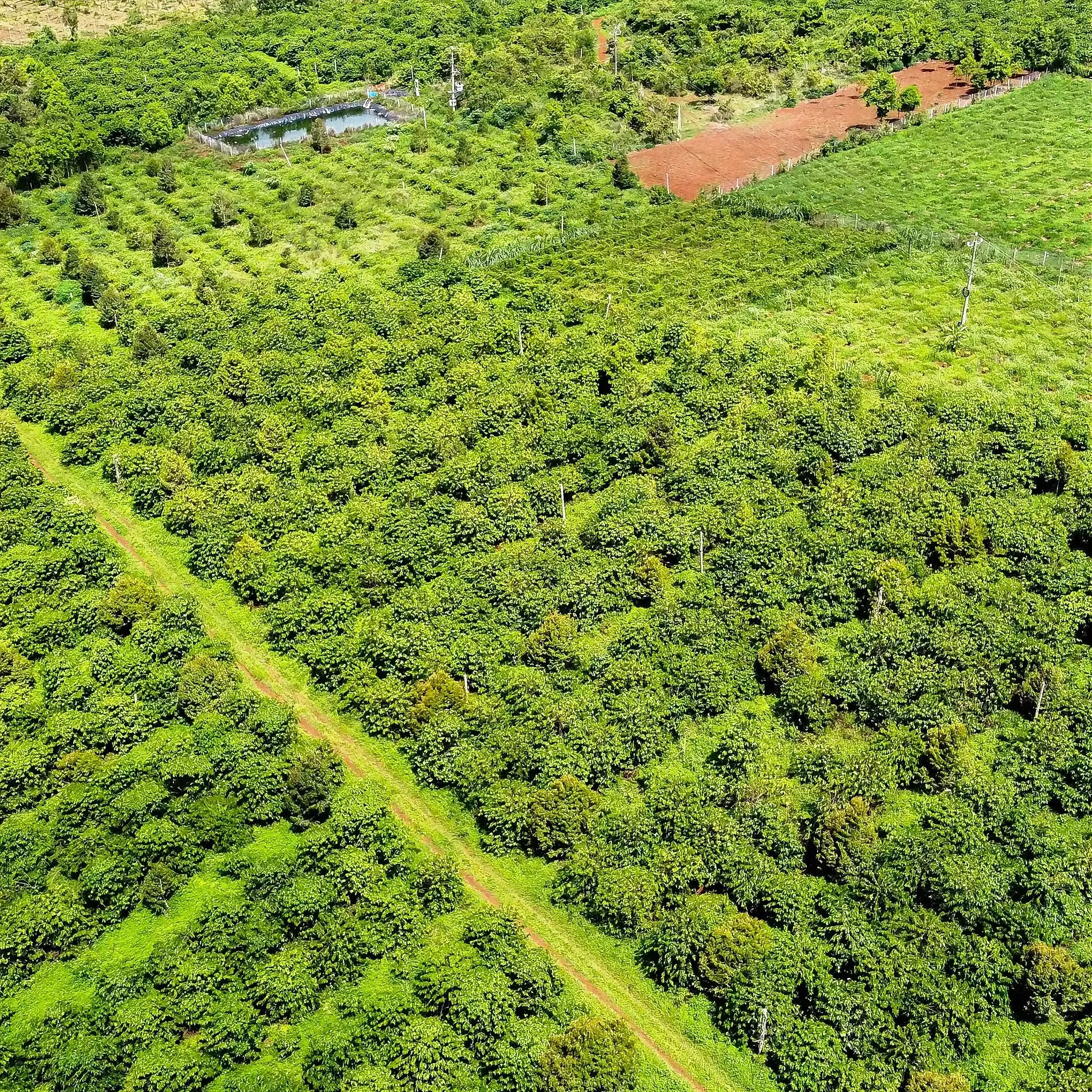
When most coffee lovers hear the name Vietnam, they think of one thing: Robusta . The country is the world's second-largest coffee producer and the absolute giant when it comes to commercial Robusta coffee. For decades, Vietnamese coffee has been associated with full, bitter, and strong flavors—often hidden under a thick layer of sweetened condensed milk in a traditional Phin brewer.
But beneath the surface, an exciting transformation is bubbling. A new generation of farmers, roasters, and baristas have decided to challenge the world's perception of Vietnamese coffee. By applying "specialty coffee thinking" to their crops, Vietnam is becoming one of the most dynamic and surprising coffee regions on the planet.
👉 Do you want to learn more about specialty coffee?
https://hallakafferosteri.com/blogg/vad-ar-specialkaffe
Coffee was introduced to Vietnam by French missionaries in the 1850s. It started on a small scale, but it was after the end of the Vietnam War and the introduction of the Đổi Mới economic reforms in 1986 that production truly exploded.
The state invested heavily in coffee as an export. The focus was entirely on quantity over quality. It was the robusta tree – known for its resistance to disease and high yields at lower altitudes – that became the country’s economic engine. Within a few decades, Vietnam went from being an insignificant player to producing almost a third of the world’s robusta coffee.
Today, approximately 95% of Vietnam’s coffee production is still Robusta. In the specialty coffee world, Robusta beans have historically had a rather bad reputation, dismissed as woody, bitter, and rubbery. However, this is often not due to the bean itself, but rather to its traditional mechanical harvesting (where unripe and defective berries are mixed in) and careless processing.
Now the rules of the game are changing with the introduction of Fine Robusta and Specialty Arabica (Specialty Coffee) . Instead of seeing robusta as a disadvantage, Vietnamese producers have begun to treat it with the same extreme care required for certified specialty coffee:
Selective handpicking: Only the absolute reddest, perfectly ripe coffee berries are picked.
Controlled fermentation: Farmers are experimenting extensively with modern anaerobic (oxygen-free) fermentation and yeast processes.
Drying infrastructure: They have invested heavily in raised drying beds and greenhouses to have full control over the drying process.
The result? A completely new flavor profile. A Vietnamese Fine Robusta of high quality retains its characteristic fullness and high caffeine content (almost twice as much as Arabica), but now offers complex notes of dark chocolate, nuts, stone fruits and a natural honey sweetness. At the same time, the proportion of high-quality, elegant Specialty Arabica (Specialty Coffee) for each year.
Vietnam's geography is surprisingly diverse, creating various unique growing conditions along the country:
Central Highlands (Đắk Lắk & Buôn Ma Thuột): This is the coffee heart of the country. With its nutritious, volcanic red basalt soil, this is the epicenter of robusta production. It is from here that the most exciting advances in Fine Robusta come. happening right now.
Da Lat (Lâm Đồng Province): Located at higher altitudes in the central highlands, the cooler climate and misty mountains around Da Lat make it the optimal region for growing high-quality Specialty Arabica (mainly the Catimor variety, but also Bourbon and Typica).
Son La: Located in the mountainous northern part of the country, coffee is grown here at an altitude of over 1,000 meters, which produces an Arabica with a significantly fresher acidity and lighter flavor profile than coffee from the southern parts.
The future of Vietnamese specialty coffee looks incredibly bright, but it is also driven by necessity. Climate change is hitting coffee belts around the world hard, and with the Arabica tree being very sensitive to temperature increases, the natural resilience of Robusta has become a huge asset for the future.
By combining the genetic strength of Robusta with sustainable farming practices (such as agroforestry to protect the environment) and modern processing technology, Vietnam has positioned itself as a key player in the future specialty coffee market. For international roasters and coffee shops, Vietnam is no longer just a source of cheap instant coffee – it is an incredibly exciting place of origin for traceable, complex and innovative artisanal coffee.
👉 Do you want to drink specialty coffee? Then visit our webshop:
Have a nice day!
/ Kaj and Dan, Hälla Coffee Roastery