
 Svenska
Cart
Your cart is empty, but doesn't have to be..
Your cart is empty, but doesn't have to be..
Hälla Kafferosteri |9/07, 2026
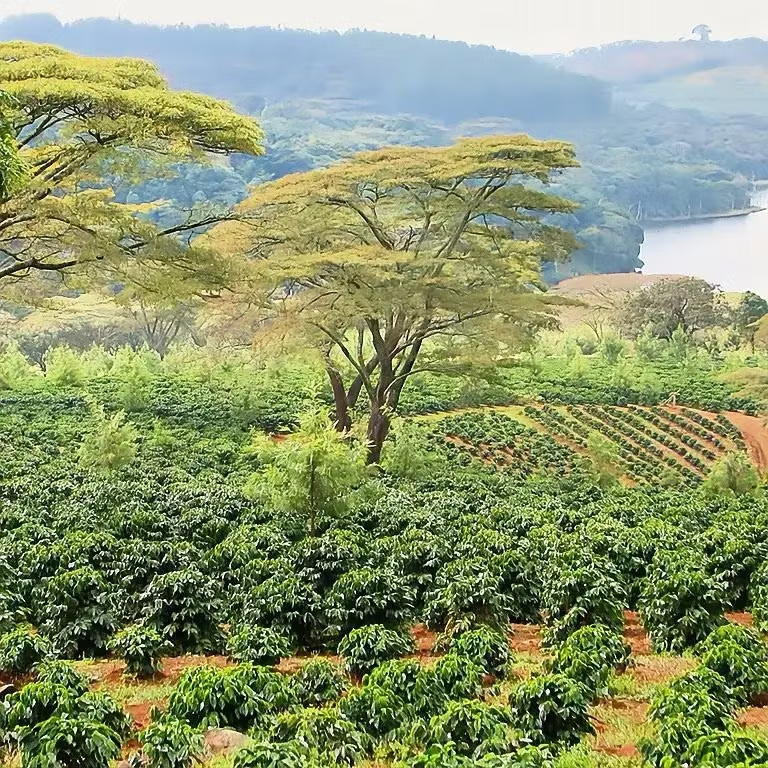
When we talk about East African coffee, it's easy to get hung up on giants like Kenya and Ethiopia. But if we move further south along the same mountain range that extends from the Ethiopian highlands, we find a country whose coffee history is as dramatic as its flavor profile is elegant: Zimbabwe .
In the early 1990s, Zimbabwe was a celebrated star on the international coffee scene. After decades of political and economic turmoil, the country almost disappeared from the coffee map. But now a quiet revolution is underway in the country's eastern highlands. With the help of international initiatives and extremely dedicated small-scale farmers, Zimbabwe is on the verge of a spectacular comeback in Specialty Coffee .
Join us at Hallå Kafferosteri as we explore the journey, challenges, and unique flavor profile of Zimbabwe's forgotten coffee treasures!
👉 Do you want to learn more about African coffee?
https://hallakafferosteri.com/blogg/afrika
Zimbabwe's coffee plantations are concentrated on the eastern border with Mozambique, in a region known as the Eastern Highlands . It is a dramatic landscape that stretches across areas such as Chipinge , Chimanimani , Vumba and the Honde Valley .
Here are the absolute dream trials of coffee:
Soil: Rich, deep and volcanic red soil.
Climate: Cooler temperatures due to the high altitude, combined with a generous rainfall of around 1375 mm per year (and up to 3000 mm in record years).
Height: Perfectly adapted for high-quality arabica (where varieties such as SL28 , Catimor and Caturra thrive).
Historically, the Vumba region produced the absolute finest premier coffee, while the larger Chipinge area accounted for around 75% of the country's total production during its heyday.
To understand why specialty coffee from Zimbabwe is so unique today, we need to look at what happened at the turn of the century.
In the early 1990s, Zimbabwe produced over 15,000 tons of coffee per year and the coffee sector employed more than 20,000 farmers. The country was often called the "agricultural basket" of Africa and coffee was the country's fifth largest export, loved globally for its pure and complex character.
After 2000, the country was hit by major economic crises, falling world market prices and radical land reforms. Large coffee haciendas were abandoned and production plummeted to less than 500 tons per year . Coffee bushes were left to grow wild, and farmers were forced to switch to faster-growing food crops such as corn and tobacco in order to survive.
The coffee renaissance begins: > The turning point came in the late 2010s. Through private and public initiatives (including major projects led by the organization TechnoServe ), support began to be given to small-scale coffee farmers. By offering training in sustainable agriculture, modern processing technology and giving farmers direct access to the specialty coffee market, thousands of farmers have returned to coffee farming. The focus is now entirely on microlots of the highest quality .
Zimbabwean specialty coffee is known for having an incredibly well-balanced and "sophisticated" character. If you brew a cup, you can expect a flavor journey characterized by:
Acidity: A clear, jasmine-like or light, berry-like acidity with vinous (wine-like) notes.
Mouthfeel: Medium body with a smooth and clean structure.
Tasting notes: A wonderful combination of dark chocolate, sweet citrus fruits and a spicy, sometimes slightly tea-like aftertaste.
It is somewhat reminiscent of the best coffees from Kenya, but often with a slightly softer acidity and a deeper chocolate base – a dream for those who love complex and elegant brewed coffee.
As production in Zimbabwe is still recovering and volumes are small, the coffee from here is very exclusive. When you buy specialty coffee from Zimbabwe, you are not only drinking a great cup of coffee – you are also directly helping to finance the rebuilding of an entire coffee community. This gives farmers the opportunity to invest in climate-smart farming techniques and creates stable long-term income.
We at Hälla Kafferosteri are passionate about this type of origin. Highlighting countries like Zimbabwe, where coffee carries a history of resilience and passion, is exactly what the specialty coffee movement is all about.
Keep an eye out for our range – when the coffee from the Eastern Highlands is harvested and lands in our roastery, you won't want to miss the chance to taste one of Africa's most exciting coffee comebacks!
Have you ever tasted coffee from Zimbabwe, or do you prefer other African origins like Ethiopia and Kenya? Let us know in the comments below, or check out our online store to find your freshly roasted favorites right now!
👉 Do you want to drink specialty coffee? Then visit our webshop:
Have a nice day!
/ Kaj and Dan, Hälla Coffee Roastery