
 Svenska
Cart
Your cart is empty, but doesn't have to be..
Your cart is empty, but doesn't have to be..
Hälla Kafferosteri |25/06, 2026
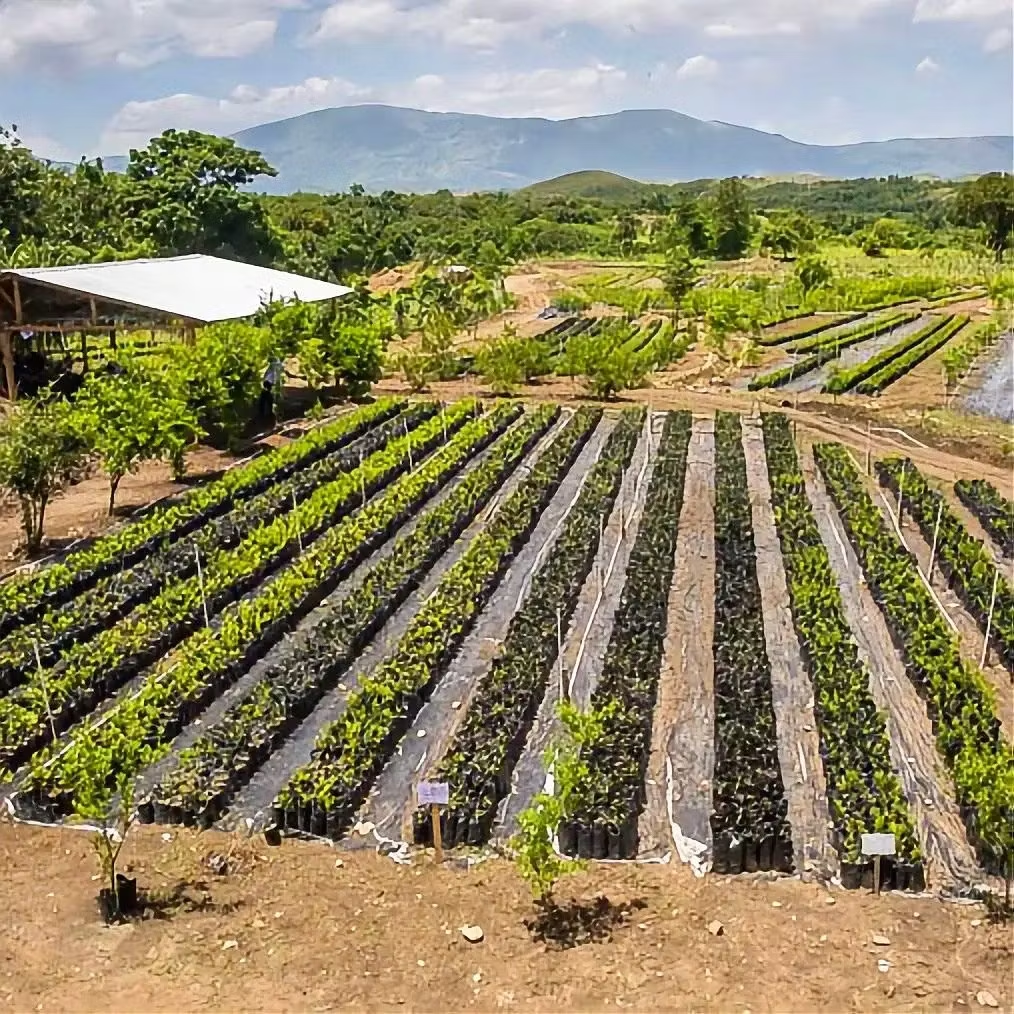
When we look for unique taste experiences in the world of coffee, we often look to well-known regions. But in the West Indies, on the mountainous island of Hispaniola, lies the Caribbean's third largest country – Haiti . Haiti is a country with an incredibly rich but also turbulent history. Among coffee enthusiasts, the country has long been a well-kept secret, but beneath the surface, an exciting movement is bubbling to reestablish the country's status as a producer of fantastic specialty coffee .
Join us at Hälla Kafferosteri as we explore the history of coffee, the unique growing methods and the enormous potential of Haitian coffee!
👉 Do you want to learn more about specialty coffee?
https://hallakafferosteri.com/blogg/vad-ar-specialkaffe
Coffee's roots in Haiti date back to the 18th century, when French colonists first brought coffee plants to the island. During that century, Haiti grew to become one of the world's largest coffee producers by volume. Along with sugar, coffee formed the backbone of the country's agricultural economy.
After Haiti became the world's first black republic and the Caribbean's first independent state in the early 19th century, coffee continued to play a crucial role in the country's economic growth. Unfortunately, recent decades have been marked by political instability and devastating natural disasters. The 2010 earthquake and recurring tropical storms hit infrastructure and coffee farms hard. Export volumes fell drastically, and today other crops such as mangoes and cocoa have overtaken coffee in export value.
But despite these enormous challenges, there is incredible resilience among the Haitian people. Organizations and cooperatives are working hard today to replant coffee trees and rehabilitate farms.
What makes Haiti unique in the coffee world is how the coffee is grown. You rarely find large, industrial plantations or commercial estates here. Instead, most of the coffee is produced by small farmers on very small plots of land, often right in their own gardens.
These are locally known as "creole gardens" . In these gardens, coffee grows wild and naturally in the shade of larger trees, mixed with other crops. This traditional form of shade farming offers several unique advantages:
Completely organic by nature: The vast majority of coffee from Haiti is grown entirely organically. However, this is rarely due to certifications, but rather because most small farmers simply cannot afford expensive chemical fertilizers or pesticides.
Ancient coffee varieties: Many of the coffee trees in Haiti are of the ancient variety Typica . The vines are often old and allowed to grow tall and limber. In addition to Typica, you can also find varieties such as Caturra, Catimor and Mundo Novo.
High-altitude microclimate: Haiti is the most mountainous nation in the Caribbean. Coffee is grown in cool, inaccessible mountain regions such as Massif du Nord , Montagnes Noires and the Massif de la Hotte , which provides fantastic conditions for high-quality Arabica.
Haiti's coffee harvest begins in September and can last until June. Everything is carefully picked by hand before the berries are delivered to local washing stations, which are often owned collectively through cooperatives.
The vast majority of Haitian coffee undergoes a washed process . Thanks to a successful development program in the 1990s, washing stations were built around the country, which has helped the cooperatives raise the quality to specialty coffee level.
The most famous coffee from the country goes by the name Haitian Blue . Named for the unique, blue-gray hue that the raw coffee beans have before they are roasted. Haitian Blue is shade-grown, washed and offers an absolutely fantastic and smooth character.
Generally speaking, Haitian specialty coffee is characterized by:
A full but soft body.
A naturally low and pleasant acidity.
Sweet, rich and balanced flavors.
An interesting problem today is that a lot of Haiti's high-quality coffee is smuggled across the border and resold as Dominican coffee, making Haiti's official export statistics look smaller than they actually are.
Haiti is a coffee origin with enormous, dormant potential. By investing in and purchasing specialty coffee from Haitian cooperatives, you are helping to create stable incomes for small farmers and build an infrastructure that can withstand future challenges.
For us at Hälla Kafferosteri, it is precisely this type of origin that gives coffee roasting a deeper meaning. Drinking Haitian coffee is not just a journey to a Caribbean mountain range – it is also a support for a people whose love for coffee has survived generations of trials.
Keep an eye out for unique lots from the Caribbean in our assortment – we are constantly looking for the next amazing gem to share with you!
👉 Do you want to drink specialty coffee? Then visit our webshop:
https://hallakafferosteri.com '
Have a nice day!
/ Kaj and Dan, Hälla Coffee Roastery