
 Svenska
Cart
Your cart is empty, but doesn't have to be..
Your cart is empty, but doesn't have to be..
Hälla Kafferosteri |22/06, 2026
Specialty Coffee from Ecuador: Ecuador's Hidden Flavor Revolution
When it comes to South American coffee, neighboring countries Colombia and Peru almost always get the spotlight. But sandwiched between these giants is Ecuador – a country that not only has the world’s tallest mountain measured from the center of the Earth, but also a coffee scene that is currently undergoing a complete transformation.
From being historically associated with cheap instant coffee, Ecuador has emerged as one of the most exciting and exclusive origins for specialty coffee. What makes Ecuadorian coffee so unique, and why is it all the rage among coffee nerds right now? Let’s delve into the history, regions, and future of Ecuadorian coffee.
👉 If you want to learn more about specialty coffee, read this blog post:
https://hallakafferosteri.com/blogg/vad-ar-specialkaffe
Coffee arrived in Ecuador around the 1830s and quickly took root in the coastal region of Manabí. Exports took off, reaching a major commercial peak in the 1970s with over a million bags exported annually. However, in the 1990s and early 2000s, the country was hit by economic instability and low world market prices, leading to the abandonment of many plantations.
A crucial historical turning point occurred in 2000 when Ecuador scrapped its own currency (Sucre) and dollarized the economy . Using the US dollar (USD) caused production costs and wages in Ecuador to rise significantly compared to neighboring countries.
The economic paradox: As coffee production became more expensive in Ecuador, the country's farmers realized they could never compete with cheap mass-produced coffee. To survive, they were forced to completely shift their focus: from quantity to extremely high quality. This was the start of Ecuador's specialty coffee revolution.
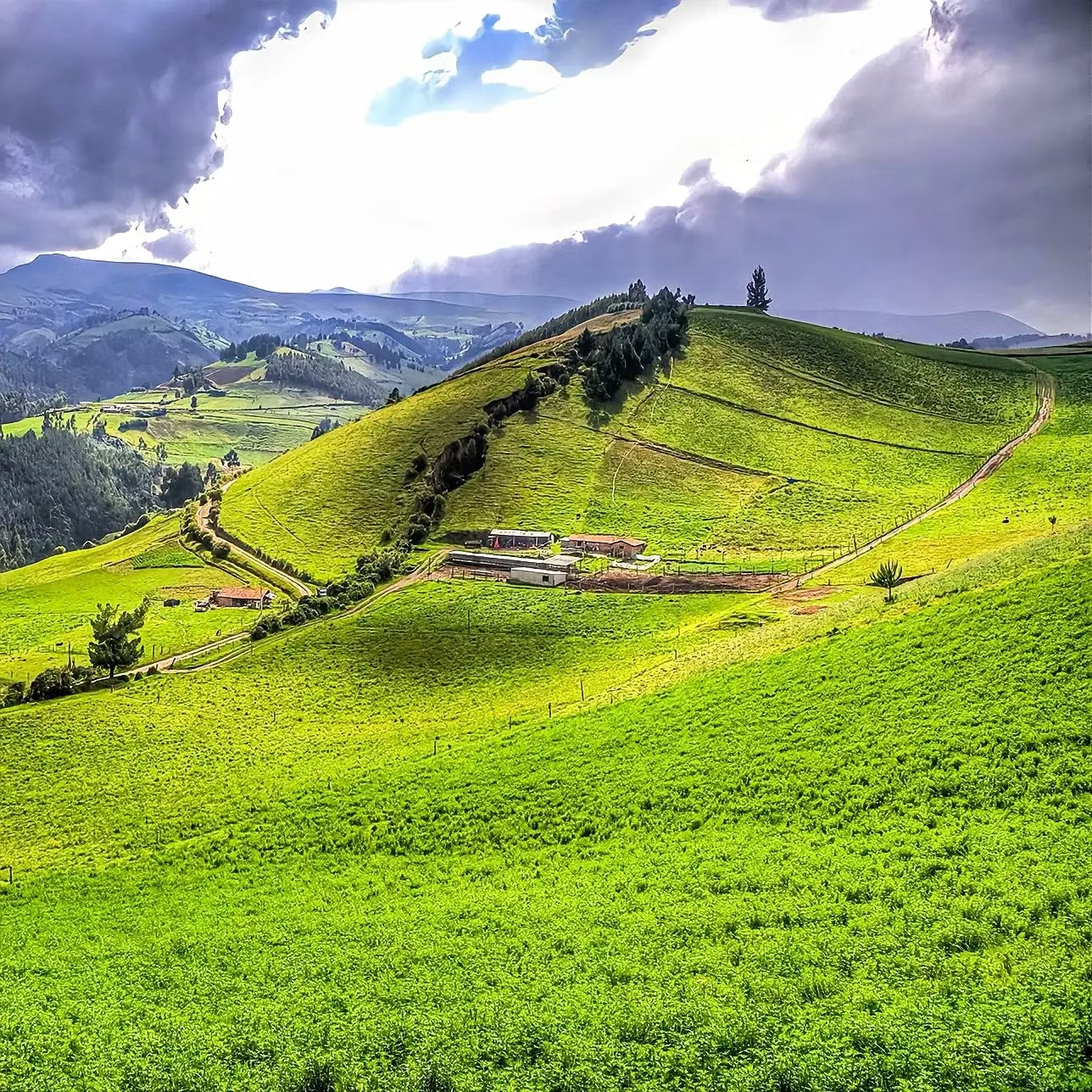
Despite its small size, Ecuador has enormous geographical diversity. According to experts interviewed by Perfect Daily Grind, the country's coffee production can be divided into three completely different zones, or "worlds":
It is in the highlands that the most sought-after specialty coffees are grown, often at dizzying heights between 1,500 and 2,300 meters above sea level.
Loja: Located in the southern Andes, this is where Ecuador's coffee heart beats strongest, with volcanic soil and a microclimate that gives the coffee an intense sweetness, balanced acidity and complex notes of stone fruit (peach, apricot and plum).
Pichincha & Imbabura (Northern Highlands): Many farms here are owned by academics and professionals from Quito (architects, doctors) who have invested in modern agricultural techniques. The coffee from here is often elegant, floral and tea-like. Exclusive varieties such as Typica Mejorado , Sidra and Gesha are grown here.
In regions like Manabí , coffee is grown at lower altitudes (600–800 meters). What makes the coast exciting is the post-harvest climate – it is very dry. This makes Manabí absolutely perfect for producing natural -processed coffee (where the coffee berry is dried completely intact with the bean inside), which produces a smooth, round cup with distinct notes of milk chocolate, nuts and caramel.
In the Amazon, high-quality robusta coffee is mainly grown for the industrial market. But the most unique microregion is the Galápagos Islands (San Cristóbal and Santa Cruz). Thanks to cold sea winds and mineral-rich volcanic soil, Arabica can be grown here at extremely low altitudes (130–400 meters) with a wonderfully balanced and round profile. As the islands are UNESCO-protected, production is tightly regulated, making Galápagos coffee one of the most expensive and rarest in the world.
Historically, Ecuador has had a strange coffee culture: the country has actually imported more green coffee than it produces. This is due to a large domestic industry that imports cheap beans, processes them into instant coffee (soluble coffee) and re-exports it to countries like Germany and Russia. Locally, Ecuadorians themselves have therefore been drinking freeze-dried instant coffee for decades.
But today, a rapid change is taking place in cities like Quito, Guayaquil, and Cuenca. The “third wave coffee culture” has exploded. Local specialty coffee shops and roasteries are popping up on almost every street corner. Young baristas and consumers have started drinking the country’s own micro-lots, and pride in local craftsmanship is growing exponentially. The country’s national barista championships now draw large crowds.
Ecuador's future in the coffee world is bright, but niche. The country will likely never become a major producer in terms of volume again. Instead, its future is focused entirely on innovation and botanical luxury .
Ecuadorian producers have become world leaders in experimental processing methods, such as anaerobic (oxygen-free) fermentation and "co-fermentation" (where the coffee ferments together with fruits or yeast strains). In addition, varieties such as Typica Mejorado have proven to deliver absolutely world-class flavors, which is why Ecuadorian coffee is now often used by competitors in the World Barista Championship.
For the coffee consumer, Ecuador means one thing: a rare, sweet, and deeply satisfying luxury that shows exactly how complex coffee can be when grown at the center of the world.
👉 Do you want to explore specialty coffee in our webshop?
https://hallakafferosteri.com/kaffe
Have a nice day!
/ Kaj and Dan, Hälla Coffee Roastery