
 Svenska
Cart
Your cart is empty, but doesn't have to be..
Your cart is empty, but doesn't have to be..
Hälla Kafferosteri |18/03, 2026
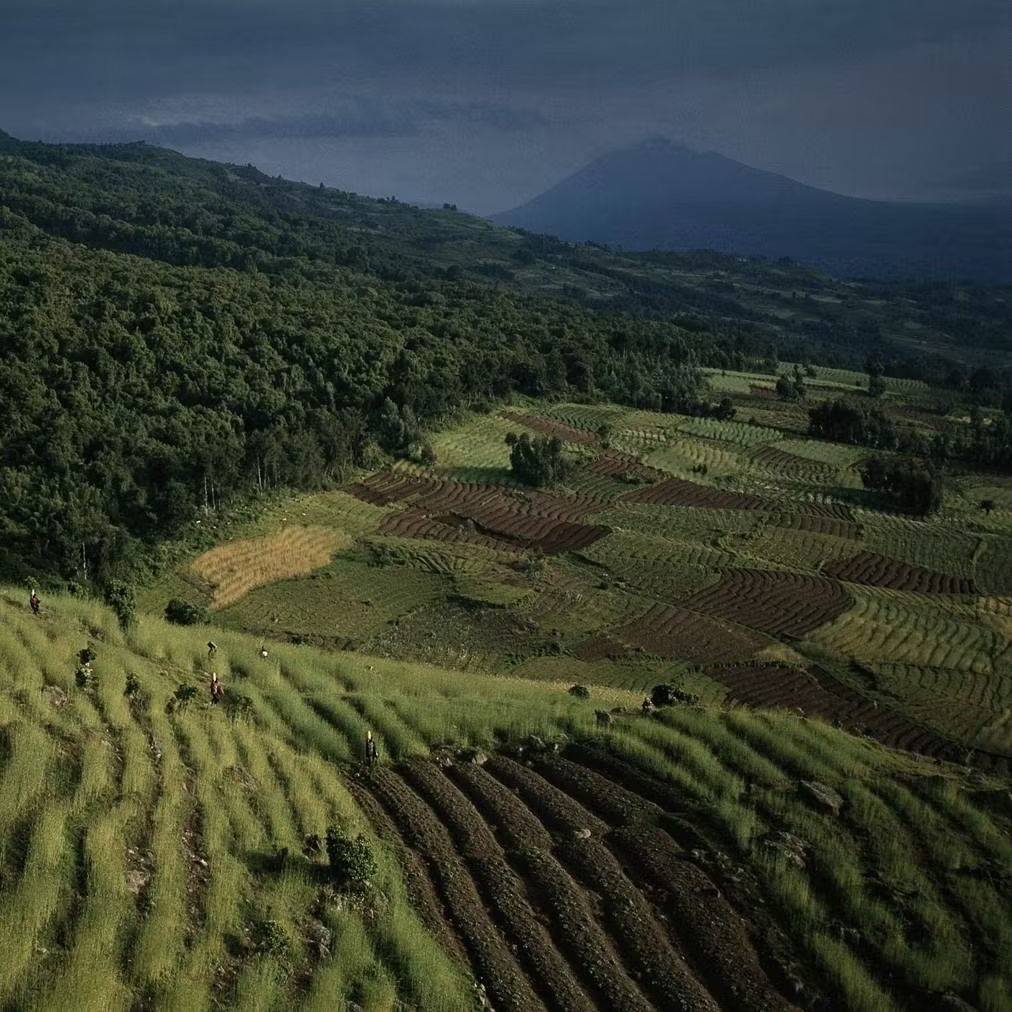
Rwanda, often called the “land of a thousand hills,” has established itself over the past two decades as one of the world’s most interesting producers of specialty coffee. Coffee here is grown at high altitudes in volcanic soil, creating complex and elegant flavors that are appreciated by coffee lovers worldwide.
But Rwandan coffee is not just about taste. It is also a story of history, reconstruction, and how an entire nation has used coffee as a tool for development.
👉 You can find our Rwanda coffee here:
https://hallakafferosteri.com/kaffe/mellanrostat-kaffe/1000-hills-rwanda-mellanrost
Rwanda's geographical and climatic conditions are ideal for coffee cultivation, especially for the Arabica variety Bourbon.
Altitude: 1,200–2,000 meters above sea level
Soil: Mineral-rich volcanic soil
Climate: Stable precipitation and temperature
Coffee variety: Bourbon (Arabica)
The high altitude allows the coffee berries to ripen slowly, resulting in more concentrated flavors. The result is a coffee that is often characterized by:
Clear and lively acidity
Notes of citrus and red berries
Floral aromas
Soft and balanced body
This makes Rwanda one of the most sought-after origins in specialty coffee.
Coffee production in Rwanda is dominated by small-scale farmers. Over 400,000 growers contribute to the country's coffee production, often with just a few hundred trees per farm.
The coffee berries are picked by hand.
Only ripe berries are selected
The berries are delivered to washing stations
The coffee is washed (washed process)
Dry thoroughly in the sun
The manual selection and washing process contribute to the clean and distinct flavor profile that Rwandan coffee is known for.
👉 You can find our Rwanda coffee here:
https://hallakafferosteri.com/kaffe/mellanrostat-kaffe/1000-hills-rwanda-mellanrost
Coffee was introduced to Rwanda in the early 20th century under German colonial control. During the subsequent Belgian colonial era, coffee production became mandatory for many farmers, with a focus on quantity rather than quality.
The 1994 genocide had catastrophic consequences for the country's economy, including the coffee industry. Infrastructure was destroyed and many farmers lost their lives or were forced to leave their farms.
During the 2000s, a comprehensive investment in quality coffee began:
Investments in washing stations
Training of growers
Focus on specialty coffee exports
Direct trade with international buyers
This transition has made Rwanda a respected player in the global coffee market.
Traditionally, almost all coffee was exported, and local coffee consumption was limited. Today, however, a modern coffee culture is emerging, especially in the capital, Kigali.
Specialty coffee shops and roasteries
Professional baristas
Coffee competitions and cupping events
Increased interest among young consumers
Coffee has thus become an important part of the country's identity, not just an export commodity.
The coffee sector plays a crucial role in Rwanda's economic and social development.
Increased income for small farmers
Stronger cooperatives and local communities
Increased economic independence for women
Sustainable rural development
Specialty coffee has shown that quality and fair trade models can create long-term change.
For those of you who want to experience Rwandan coffee at home, there are several excellent options in specialty coffee.
A classic Rwandan profile with clear acidity and notes of citrus and red berries. Perfect for pour-over and filter brewing.
A more complex coffee with floral notes and a sweet, berry finish. Suitable for both filter and lighter espresso.
For those who want to try something different. Provides fuller body and more intense fruity flavors, often with hints of tropical fruit.
Tip: Look for freshly roasted beans from specialty roasters and check the roasting date for the best flavor experience.
Rwanda has quickly gone from being an anonymous coffee producer to one of the world's most exciting origins of specialty coffee. The combination of ideal growing conditions, small-scale craftsmanship and a strong desire for development has created world-class coffee.
Drinking Rwandan coffee is therefore more than a taste experience. It is an insight into a country's history, culture and future.
👉 You can find our Rwanda coffee here:
https://hallakafferosteri.com/kaffe/mellanrostat-kaffe/1000-hills-rwanda-mellanrost
Have a nice day!
/ Kaj and Dan, Hälla Coffee Roastery