
 Svenska
Cart
Your cart is empty, but doesn't have to be..
Your cart is empty, but doesn't have to be..
Hälla Kafferosteri |11/06, 2026
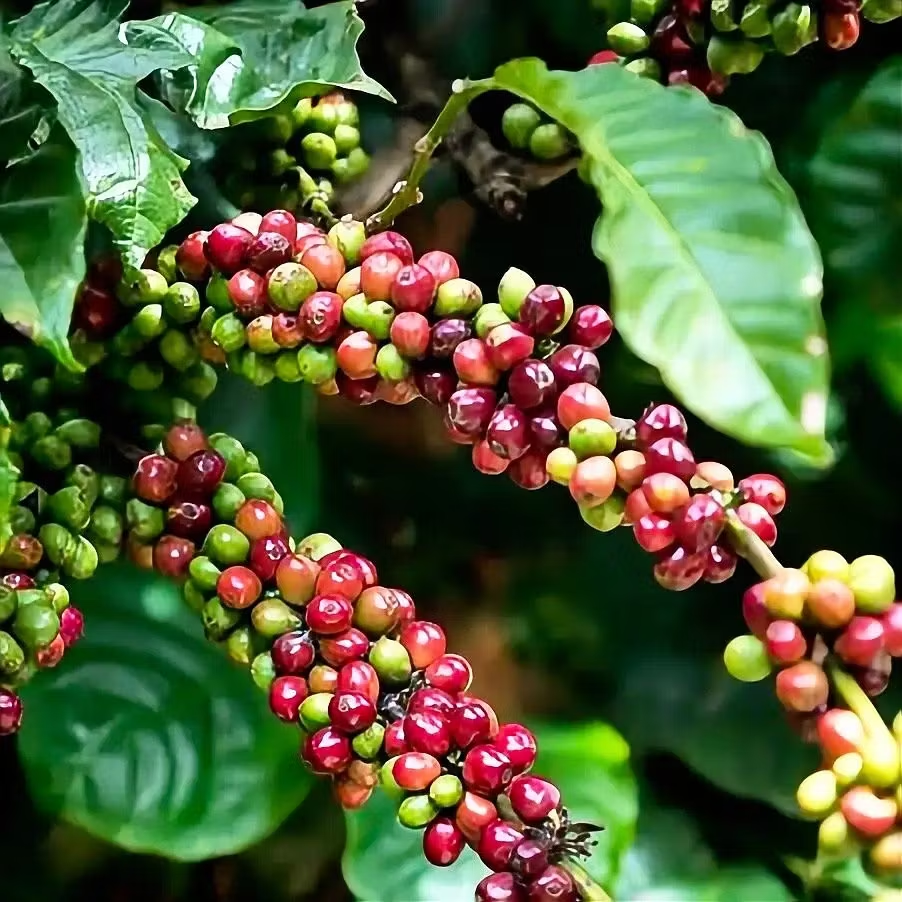
When we think of coffee countries in Africa, we often think of Ethiopian highland beans or fruity coffee from Kenya. But there is a country on the west coast with a completely unique coffee history and its own, wild coffee treasure. We are talking about Liberia.
Although the country currently struggles with modest production, one of the world's most exciting and robust coffee varieties is hidden here. Let's delve into the history, challenges and potential currently bubbling beneath the surface of the Liberian coffee industry.
👉 Do you want to learn more about African coffee?
https://hallakafferosteri.com/blogg/afrika
Liberia is Africa's oldest republic, declaring its independence in 1847. The country's modern history is strongly influenced by the freed American slaves who migrated there in the 19th century under the leadership of the American Colonization Society. With financial support and investment from the United States, Liberia began to build up its exports. This was mainly natural rubber, but small volumes of coffee also found their way onto the world market.
Coffee production in Liberia reached its peak in 1985, when the country produced a whopping 209,000 bags (60 kg each) of coffee. Unfortunately, history dealt a heavy blow to the industry. After a military coup in 1980 and a subsequent civil war that broke out in 1989, the country entered decades of political unrest and devastating conflicts. Thousands of people lost their lives, and coffee plantations were abandoned when farmers were forced to flee.
Once peace came, many farmers chose to focus on more profitable crops such as cocoa and rubber, which caused coffee production to drop dramatically.
Coffee cultivation in Liberia is concentrated in the northern and central parts of the country, where the climate and nutrient-rich soil create the best conditions. Three regions in particular account for the majority of the country's production:
Nimba: Located in the central-northern part of the country, it is a mountainous region with cooler temperatures and abundant rainfall, making it one of the country's main agricultural hubs – not only for coffee but also for cocoa.
Praise: This region is located in the upper northwest and borders both Guinea and Sierra Leone. Historically, Lofa has been known as the "breadbasket" of Liberia and has a long tradition of coffee cultivation on its fertile plains and hills.
Bong: The Bong region is strategically located in central Liberia and connects the coffee plantations in the north with the transport routes down to the coast.
In these regions, it is currently mainly robusta coffee that is grown on a commercial basis, but it is also here that the potential for scaling up production of the unique liberica bean is greatest.
Although most coffee grown in the central and northern parts of the country today is robusta, Liberia is best known for a completely different species: Coffea liberica .
Liberica coffee grows wild in the tropical forests of West and Central Africa. In the 1870s, the species spread to Southeast Asia to save their coffee plantations after the dreaded fungal disease coffee leaf rust virtually wiped out all the arabica coffee there. Around the turn of the century, liberica was actually as big as arabica in some parts of the world!
So what makes Liberica so special?
Large berries: The coffee berries are unusually large, which helps concentrate the sweetness and give the coffee an extremely long and full-bodied aftertaste.
Resistant plant: It is a robust and high-yielding plant that thrives at low altitudes.
Wild: In the Liberian forests, the trees grow completely wild. However, there is a downside to this – the trees grow so enormously tall that the berries are often difficult or impossible to harvest.
After its heyday, demand waned as the large berries proved difficult to process, leading to inconsistent quality. But today, thanks to the specialty coffee scene's search for new flavors (notably highlighted during the World Barista Championship), interest in Liberica has revived.
Producing coffee in Liberia today is far from easy. The sector is disorganized and local experts such as Robert Kollie (Green Future Agro) and Tyler Papula (Liberica Coffee Company) testify to major infrastructural and technical challenges:
Lack of equipment: There are extremely few coffee processing plants in the country. Most farmers dry their berries in the sun and are then forced to cross the border to Ivory Coast or Guinea to shell and thresh their coffee ( dry milling ).
Lack of domestic market: Since the coffee is processed and sold in neighboring countries, almost no Liberian coffee is consumed in Liberia. What people drink instead is imported instant coffee.
Bad roads: The road network from the growing regions to the capital, Monrovia, is often so poor that farmers have difficulty even transporting their crops.
Financial support: There is a lack of government loans and resources to purchase fertilizers and high-quality cuttings.
Despite the headwinds, there is strong hope for the future. Organizations such as the International Trade Centre (ITC) have begun distributing thousands of new coffee plants to farmers and organizing workshops.
The goal of the local cooperatives is to keep the processing – and therefore the money – in the country. By investing in their own threshing machines and teaching the farmers to roast and taste their own coffee, they hope to increase both quality and pride. There is plenty of mountainous, nutrient-rich soil that is perfect for quality coffee – what is needed now is a functioning support system.
Liberia's coffee journey has only just begun. The next time you sip a cup of specialty coffee, look out for the rare and legendary The Liberica bean – a taste of a country that refuses to let its coffee tradition be lost.
👉 Do you want to drink specialty coffee? Then visit our webshop:
Have a nice day!
/ Kaj and Dan, Hälla Coffee Roastery