
 Svenska
Cart
Your cart is empty, but doesn't have to be..
Your cart is empty, but doesn't have to be..
Hälla Kafferosteri |10/07, 2026
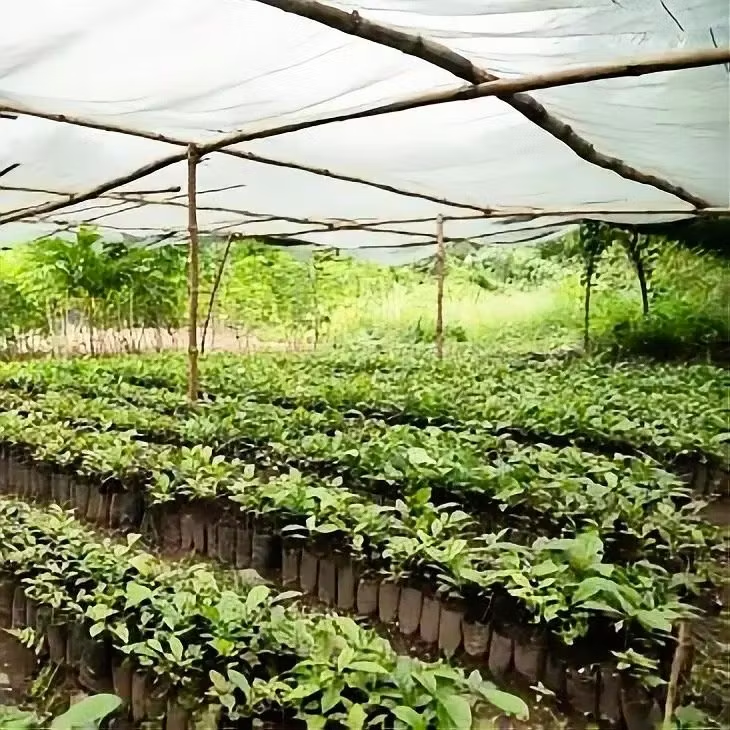
When we think of Ghana and hot drinks, there is one ingredient that immediately steals the show: cocoa. Ghana is one of the world's largest cocoa producers, and the golden brown beans have shaped the country's economy and culture for generations. But alongside the vast cocoa plantations, a new, exciting movement is quietly emerging. Welcome to Ghana – Africa's next exciting stop on the Specialty Coffee map!
Ghana’s coffee production has long been overshadowed by neighboring Ivory Coast and its own cocoa market. But driven by increased global interest in unique origins, government rehabilitation programs, and a new wave of passionate local entrepreneurs, Ghana is redefining what West African coffee can be.
Join us at Hälla Kafferosteri as we explore Ghana's coffee history, its unique conditions and why you should keep an eye on this origin in the future!
👉 Do you want to learn more about African coffee?
https://hallakafferosteri.com/blogg/afrika
The history of coffee in Ghana dates back to the mid-18th century, when it was introduced by early missionaries. The crop gained a foothold in the traditional cocoa regions, but due to lack of market access, limited government support and the fact that cocoa was significantly more profitable, many coffee farms were abandoned in the late 20th century.
The turning point came in the 2010s. Through government initiatives such as the Coffee Rehabilitation Project (CRP) and the Planting for Export and Rural Development (PERD) program through Ghana COCOBOD, improved planting materials have been actively developed and distributed to farmers. Old, abandoned farms have been brought back to life, and production has steadily increased. Coffee has gone from being a forgotten sideline to becoming a strategic and profitable option for small-scale farmers.
When we talk about specialty coffee, we usually think of Arabica. But Ghana challenges the classic image by being a distinctly Robusta country .
Geographically, Ghana is relatively low-lying. Even at the country's highest point, Mount Afadja, the terrain only reaches around 885 meters above sea level – which is too low for Arabica beans to thrive. However, the conditions are absolutely optimal for high-quality fine Robusta:
Regions: Coffee is grown primarily by smallholders scattered in regions such as Volta (especially in the lush Volta Mountains), Eastern , Ashanti , Central and Western .
Climate: A steady average temperature of between 24–30 °C, high humidity and an annual rainfall of 1200 to over 2000 mm gives the coffee bush exactly what it needs.
Harvest season: The coffee cycle typically runs from October to September of the following year, with intensive picking periods during the winter months.
Thanks to research from the Cocoa Research Institute of Ghana (CRIG), new hybrid varieties have been developed that are not only resistant to climate change, but also deliver significantly better and cleaner cup quality than traditional industrial robusta.
Forget the image of bitter and woody instant coffee. When robusta is grown and processed with the same care as specialty coffees – where the berries are hand-picked when perfectly ripe and gently dried in the sun – something magical happens to the flavor profile. Nigerian and Ghanaian coffees often offer:
Body: An extremely full-bodied, almost creamy mouthfeel with a thick and beautiful crema if brewed as an espresso.
Tasting notes: Deep and rich notes of dark cocoa, roasted almonds, spices and a subtle earthy sweetness.
Acidity: Very low acidity, making it perfect for those who prefer a round, powerful and balanced cup without pungent citrus notes.
This makes Ghanaian robusta a fantastic component in espresso blends to provide stability and body, but also an exciting single origin for those who want to explore the full potential of robusta.
What makes Ghana's coffee scene particularly inspiring is the enormous local drive. In the capital Accra and in the growing areas, pioneering local roasteries and brands (such as Kawa Moka , a 100% women-owned company, and Jamestown Coffee Roasters ) have established themselves.
These pioneers work directly with hundreds of smallholder farmers, train young people and women in the coffee craft, and ensure that a larger part of the coffee value chain remains in the country. At the same time, an urban coffee culture is emerging, with the younger generation in Ghana increasingly choosing local artisanal coffee over tea or imported instant coffee.
Following developments in countries like Ghana reminds us that the coffee world is in constant flux. Specialty coffee is no longer just about looking at traditional Arabica countries, but about discovering the craft and potential where passionate people make a difference.
At Hälla Kafferosteri, we are keeping an extra eye on Ghana's Volta region. Being able to offer a traceable, carefully produced and uniquely full-bodied West African robusta is something we look forward to in the future. Keep an eye on the online store - the coffee world's new upstart could soon be in your cup!
Have you ever tried a high-quality fine Robusta, or do you prefer Arabica? Share your thoughts and taste experiences in the comments below, or check out our current range of freshly roasted specialty coffee in the online store!
👉 Do you want to drink specialty coffee? Then visit our webshop:
Have a nice day!
/ Kaj and Dan, Hälla Coffee Roastery