
 Svenska
Cart
Your cart is empty, but doesn't have to be..
Your cart is empty, but doesn't have to be..
Hälla Kafferosteri |3/06, 2026
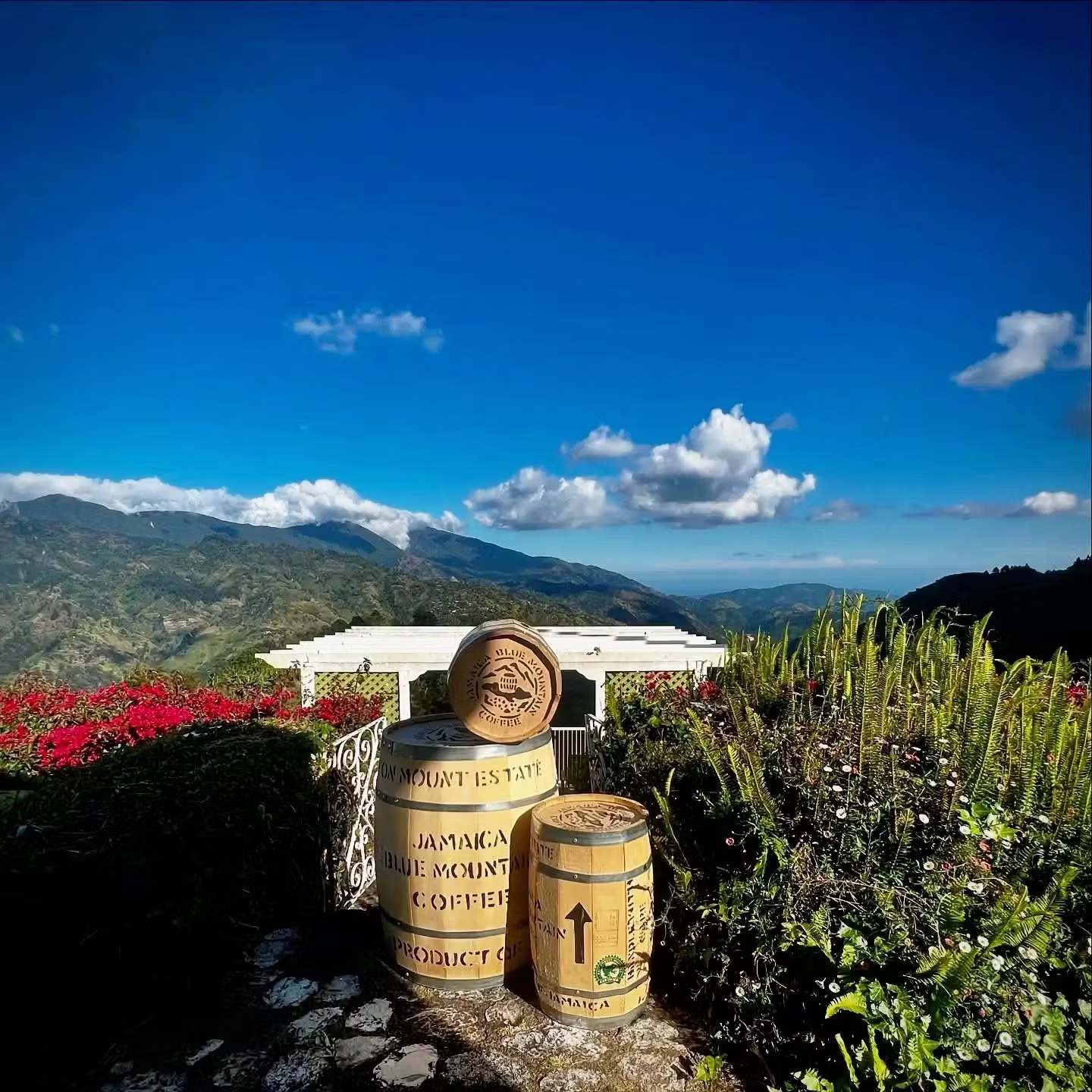
There are few coffees in the world whose origin and production chain are as tightly regulated as Jamaica Blue Mountain . Many people know it as an exclusive coffee packaged in wooden barrels, but the history and craftsmanship behind the scenes span almost 300 years.
At Hälla Kafferosteri we love coffee with a clear history. Let's take a closer look at the unique facts, the rich history and the uncompromising quality control that define authentic Jamaica Blue Mountain.
👉 Do you want to learn more about specialty coffee?
https://hallakafferosteri.com/blogg/vad-ar-specialkaffe
The history of Jamaican coffee can actually be traced back to a decision by French King Louis XV. In 1723, he sent three coffee plants to the French colony of Martinique in the Caribbean. Five years later, in 1728, Jamaica's governor, Sir Nicholas Lawes, received a plant as a gift from the governor of Martinique.
It was from this single, carefully tended plant of the Arabica Typica subspecies that the entire Jamaican coffee industry was born. Within nine years, the craft bore fruit and Jamaica was able to export its very first coffee.
Not just any Jamaican coffee can be called Blue Mountain. The region is globally protected and cultivation is limited to a total area of around 6,000 hectares – which is equivalent to the size of a single large coffee plantation in the more high-producing coffee countries.
To be certified, the coffee must be grown at steep elevations of up to 1,800 meters within four specific counties ( Parishes ):
Portland
St. Andrew
St. Mary
St. Thomas
The mountain range rises to 2,350 meters above sea level, and here the Arabica Typica bean thrives best in the nitrogen- and phosphorus-rich volcanic soil. The constant, cool mist blanket protects the plants from the strong Caribbean sun, which slows down the ripening process of the berry. This gives the coffee its characteristic full body, mild acidity and rich aroma.
Coffee farming in the Blue Mountains is predominantly a small-scale craft industry. There are around 15,000 smallholders and estates in the region, with the majority of smallholdings being smaller than 4 hectares.
The post-harvest process is time-consuming and strictly controlled:
Resting in parchment: After harvesting and washing, the coffee is stored in its protective parchment skin (either in sacks or in large wooden silos) for at least 8 weeks. This resting period is critical for the flavors to stabilize.
Mechanical and manual sorting: Once the coffee is shelled, the beans are sorted by both size and density using vibrating screens and gravity tables.
Hand-picked defects: To achieve the highest classification, Grade 1 , the batch must contain a maximum of 2% defects. All defective beans are completely removed by hand. Grade 1 beans are also screened to an exact size of 17+ (6.75 mm) and have a controlled moisture content of 10.5–11.5%.
The wooden barrels: Only after this strict process is the finished green coffee packed into the iconic wooden barrels (in sizes 70 kg, 30 kg or 15 kg) for export.
The reason Jamaica Blue Mountain maintains its exclusive status is largely a matter of supply and demand. The annual production of green coffee is very limited, and between 65% and 80% of the total harvest is traditionally exported directly to Japan.
What is left over for the rest of the world's roasters and coffee lovers is negligible. It is a balanced, smooth and historic coffee – a classic that carries a unique heritage from the misty mountain peaks of the Caribbean.
Have you had the privilege of trying authentic, certified Jamaica Blue Mountain coffee?
👉 Do you want to drink specialty coffee? Then visit our webshop:
Have a nice day!
/Kaj and Dan, Hälla Coffee Roastery